



In brief
Carpal tunnel syndrome is the most common compressive neuropathy of the upper limb, caused by compression of the median nerve beneath the transverse carpal ligament. It combines night-time paraesthesiae in the median territory (thumb, index finger, middle finger, radial border of the ring finger), night-time waking, relief on shaking the hand (Flick sign) and grip weakness. Diagnosis is essentially clinical, Durkan's carpal compression being the most sensitive test and nerve conduction studies the gold standard. First-line treatment of mild to moderate forms combines a neutral-position night splint with nerve and tendon gliding exercises. Its symptomatic prevalence is 3.8%.
Clinical synthesis based on the Clinical Practice Guidelines JOSPT 2019 (Erickson et al., PMID 31039690), the AAOS 2024 CPG, the Cochrane review by Karjalainen 2023 on splinting (PMID 36848651) and the 2021-2024 meta-analyses.
Clinical synthesis
- Carpal tunnel syndrome (CTS) is the most common compressive neuropathy of the upper limb: compression of the median nerve beneath the transverse carpal ligament¹.
- Symptomatic prevalence of 2.7-3.8% in the general population (Atroshi 1999 JAMA, n=3000)², pooled incidence of 3 cases/1000 person-years in workers (Dale 2013)³, with a female predominance (sex ratio ≈ 3:1) between 45 and 60 years of age¹.
- The classic symptoms : night-time paraesthesiae in the median territory (thumb, index finger, middle finger, radial half of the ring finger), night-time waking, relief from the "Flick sign" (shaking the hand), grip weakness⁴.
- Major risk factors: diabetes (OR 1.97)⁵, obesity BMI > 30 (OR 2.12)⁶, pregnancy (34% with symptoms, Meems 2015)⁷, occupations involving hand-arm vibration and forceful repetitive movements (Hassan 2022, GRADE high)⁸.
- Diagnosis is essentially clinical : the Durkan carpal compression test is the most sensitive provocative test (Sn ~80 %); Tinel's sign is unreliable (Sn < 50 %)⁹. Ultrasound (median nerve CSA > 10-12 mm² at the pisiform) and nerve conduction studies (the gold standard, with 10-15% false negatives) confirm severity (Bland 2000 classification)¹⁰.
- The main differential diagnosis is C6-C7 cervical radiculopathy (Wainner 2003 cluster); do not forget thoracic outlet syndrome, the pronator teres syndrome and systemic neuropathies (diabetes, polyneuropathies)¹¹.
- First-line treatment for mild to moderate forms: a neutral-position night splint (Karjalainen 2023 Cochrane, moderate evidence, OR for improvement 3.86)¹², combined with nerve and tendon gliding exercises (Ballestero-Pérez 2021 JOSPT, meta-analysis of 10 RCTs)¹³.
- The corticosteroid injections are superior to splinting at 6 weeks but the effect fades by 6 months (Chesterton 2018 Lancet INSTINCTS, n=234)¹⁴; surgery is indicated in cases of thenar atrophy, motor deficit or failure of 3-6 months of well-conducted treatment (Jarvik 2009 Lancet)¹⁵.
- Atypical or resistant cases: consider anatomical variants (bifid median nerve 8.6%, Walker 2014; persistent median artery 3.7%, Solewski 2021), intracanal ganglia, lipomas and schwannomas, for which ultrasound is the tool of choice¹⁶.
- Outcome measurement : Boston Carpal Tunnel Questionnaire (BCTQ) from Levine 1993 (MCID 0.5-1 point on the SSS/FSS), QuickDASH (MCID 8 points), grip strength on the Jamar dynamometer, BCTQ MCID in women 2023 (López-de-Uralde-Villanueva)¹⁷.
Contents
- What are the fundamentals to know about carpal tunnel syndrome?
- How can carpal tunnel syndrome be assessed and diagnosed with certainty?
- Which treatment strategies are most effective for carpal tunnel syndrome?
- How can lasting recovery be secured and recurrence of carpal tunnel syndrome prevented?
- What do real-world case studies teach us about carpal tunnel syndrome?
- How do you apply these recommendations concretely in your practice?
What are the fundamentals to know about carpal tunnel syndrome?
How is this condition defined, who is affected and what are the risk factors?
Carpal tunnel syndrome (CTS) is the most common compressive neuropathy of the upper limb¹. It results from compression of the median nerve within the osteofibrous tunnel formed by the carpal bones (floor and side walls) and the transverse carpal ligament (roof). Any rise in pressure within this inextensible space compromises intraneural microcirculation and causes segmental ischaemia, giving rise to paraesthesiae and progressive demyelination². 🤏 Epidemiology 📊: symptomatic prevalence in the general population is 3.8% for typical symptoms and 2.7% for cases confirmed by nerve conduction studies (Atroshi et al. 1999, JAMA, n=3,000 Swedish adults)³. The incidence among American workers is estimated at 3.07 cases per 1,000 person-years (Dale 2013, pooling of 6 prospective cohorts, n=4,321)⁴. A recent worldwide meta-analysis (Gebrye et al. 2024, n=78 studies) reports a pooled overall prevalence of about 3.8 % with wide regional heterogeneity⁵. Demographics : overall, women are 2 to 3 times more often affected than men¹⁶, with a peak incidence between 45 and 60 years⁷.📈 CTS risk factors: odds ratios (95% CI)
Meta-analyses published 2015-2024: verified sources Pourmemari 2016, Shiri 2015, Hassan 2022, Meems 2015
Summary of ORs and prevalence from recent meta-analyses. Diabetes and obesity are the major metabolic factors, whereas vibration and forceful repetitive movements are the best-established occupational factors (GRADE high, Hassan 2022). Pregnancy is a major transient factor (34% of women in the third trimester, Meems 2015). Sources: PMID 26395787 · PMID 26173490 · PMC9629628 · PMID 25778497.
- Pregnant women : 34% with symptoms in the 3rd trimester in the prospective Meems 2015 cohort (n=648; BJOG)⁸. A review by Cîmpeanu 2024 confirms that "de novo" CTS of pregnancy is frequently reversible after delivery but may warrant a night splint⁹.
- People with diabetes : OR 1.97 (95% CI 1.57-2.46) across all forms, with duration of diabetes and poor glycaemic control acting as aggravating factors⁵.
- Exposed workers : the Hassan 2022 meta-analysis (Health Sci Rep, GRADE high) confirms the association between hand-arm vibration, forceful repetitive movements and CTS⁸; Gerger 2024 adds the psychosocial dimension of work (stress, low job control)¹⁰.
- Patients with rheumatoid arthritis, hypothyroidism or chronic kidney disease : well-documented systemic factors, but of modest effect¹.
What happens in the body and how does carpal tunnel syndrome evolve naturally?
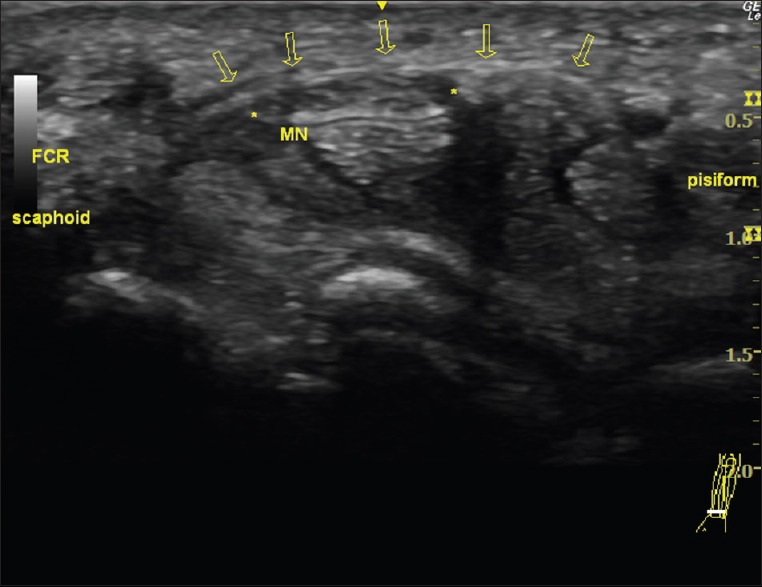
UltrasoundTransverse wrist ultrasound showing a markedly enlarged median nerve within a carpal tunnel with an intact transverse ligament, in a patient with carpal tunnel syndrome.
Source : Shapiro et al., Journal of clinical imaging science, 2016, figure 2 · CC BY-NC-SA
- Raised intracarpal pressure : resting pressure rises from 2-10 mmHg (normal) to 30-40 mmHg in wrist flexion or extension, exceeding the critical threshold for endoneurial capillary perfusion (~30 mmHg)².
- Endoneurial ischaemia and intraneural oedema : venous congestion worsens the pressure, creating a vicious circle. At this stage symptoms are intermittent and reversible².
- Segmental demyelination then axonal degeneration : if compression persists, large-diameter fibres (myelinated sensory fibres) are affected first, then motor fibres, hence the late thenar atrophy¹¹.
- Constant (non-intermittent) symptoms¹²
- Symptom duration > 10 months¹²
- Initial electrophysiological severity (Bland grade ≥ 4)¹³
- Presence of metabolic comorbidities (diabetes, obesity)⁵⁶
- Thenar atrophy or motor deficit: early surgical indication⁷
🚩 Warning signs calling for prompt medical referral
- Thenar atrophy or progressive motor deficit (abductor pollicis brevis) → early surgical referral to avoid irreversible sequelae
- Palpable mass at the wrist, local inflammatory signs → suspected structural lesion (ganglion, lipoma, schwannoma), so ultrasound in every case
- Symmetrical bilateral symptoms with proximal spread and glove-pattern sensory loss → suspected polyneuropathy (diabetic, alcoholic, paraneoplastic)
- Recent history of trauma to the wrist with major oedema → occult fracture, compartment syndrome
- Unexplained mechanical night pain, weight loss, fever → systemic work-up essential
- CTS is a compressive neuropathy of the median nerve at the wrist, with a symptomatic prevalence of 3.8% in the general population (Atroshi 1999).
- Women aged 45-60 (3:1 ratio), major risk factors: diabetes (OR 1.97), obesity (OR 2.12), vibration, forceful repetitive movements, pregnancy (34%).
- Pathophysiology: pressure → endoneurial ischaemia → oedema → demyelination. The night splint breaks this vicious circle.
- Course: 30-50% spontaneous improvement at one year in mild forms (Burton 2016), but constant forms may worsen.
- ⚠️ Thenar atrophy, motor deficit or a palpable mass → surgical referral or imaging work-up without delay.
Bibliography
- Padua L, Coraci D, Erra C, et al. Carpal tunnel syndrome: clinical features, diagnosis, and management. Lancet Neurol. 2016;15(12):1273-1284. PMID 27751557.
- Werner RA, Andary M. Carpal tunnel syndrome: pathophysiology and clinical neurophysiology. Clin Neurophysiol. 2002;113(9):1373-1381. PMID 12169318.
- Atroshi I, Gummesson C, Johnsson R, Ornstein E, Ranstam J, Rosén I. Prevalence of carpal tunnel syndrome in a general population. JAMA. 1999;282(2):153-158. PMID 10411196.
- Dale AM, Harris-Adamson C, Rempel D, et al. Prevalence and incidence of carpal tunnel syndrome in US working populations: pooled analysis of six prospective studies. Scand J Work Environ Health. 2013;39(5):495-505. PMID 23423472.
- Pourmemari MH, Shiri R. Diabetes as a risk factor for carpal tunnel syndrome: a systematic review and meta-analysis. Diabet Med. 2016;33(1):10-16. PMID 26173490.
- Shiri R, Pourmemari MH, Falah-Hassani K, Viikari-Juntura E. The effect of excess body mass on the risk of carpal tunnel syndrome: a meta-analysis of 58 studies. Obes Rev. 2015;16(12):1094-1104. PMID 26395787.
- Sevy JO, Sina RE, Varacallo M. Carpal Tunnel Syndrome. In: StatPearls [Internet]. Treasure Island (FL): StatPearls Publishing; 2024. NBK448179.
- Hassan A, Beumer A, Kuijer PPFM, van der Molen HF. Work-relatedness of carpal tunnel syndrome: Systematic review including meta-analysis and GRADE work-relatedness scoring. Health Sci Rep. 2022;5(6):e888. PMC9629628.
- Meems M, Truijens S, Spek V, Visser LH, Pop VJ. Prevalence, course and determinants of carpal tunnel syndrome symptoms during pregnancy: a prospective study. BJOG. 2015;122(8):1112-1118. PMID 25778497.
- Gerger H, Macri EM, Jackson JA, et al. Physical and psychosocial work-related exposures and the incidence of carpal tunnel syndrome: A systematic review of prospective studies. Appl Ergon. 2024;117:104211. PMID 38199092.
- Schmid AB, Hailey L, Tampin B. Entrapment Neuropathies: Challenging Common Beliefs With Novel Evidence. J Orthop Sports Phys Ther. 2018;48(2):58-62. PMID 29385943.
- Burton CL, Chesterton LS, Chen Y, van der Windt DA. Clinical Course and Prognostic Factors in Conservatively Managed Carpal Tunnel Syndrome: A Systematic Review. Arch Phys Med Rehabil. 2016;97(5):836-852.e1. PMID 26440776.
- Ortiz-Corredor F, Enríquez F, Díaz-Ruíz J, Calambas N. Natural evolution of carpal tunnel syndrome in untreated patients. Clin Neurophysiol. 2008;119(6):1373-1378. PMID 18396098.
- Gebrye T, Jeans E, Yeowell G, Mbada C, Fatoye F. Global and Regional Prevalence of Carpal Tunnel Syndrome: A Meta-Analysis Based on a Systematic Review. Musculoskeletal Care. 2024;22(4):e70024. PMID 39672798.
- Cîmpeanu MC, Roman N, Grigorescu S, Grigorescu OD, Miclăuș RS. Management of "De novo" Carpal Tunnel Syndrome in Pregnancy: A Narrative Review. J Pers Med. 2024;14(3):240. PMID 38540982.
How can carpal tunnel syndrome be assessed and diagnosed with certainty?
Which questions should you ask to understand the patient and their history?
Patient history is the cornerstone of CTS diagnosis. The aim is to bring out the semiological pattern characteristic of median nerve compression and to identify triggering and aggravating factors¹. 🧐 The key questions to explore systematically:- Symptom topography : paraesthesiae, hypoaesthesia or pain in the territory of the median nerve (thumb, index finger, middle finger and radial half of the ring finger)². Involvement of the little finger or of the dorsal aspect should suggest another diagnosis³.
- Circadian rhythm : overall, night-time awakenings from paraesthesiae are the most specific feature of CTS, present in 60-70% of patients¹⁴.
- Flick sign : the patient shakes the hand to relieve the symptoms, a highly suggestive sign (Pryse-Phillips 1984; Amirfeyz 2005)⁵.
- Triggering factors : driving, prolonged reading, phone use, sustained flexion/extension postures⁴.
- Functional impact : clumsiness, dropping objects, weakness of fine grip, which may indicate early motor involvement².
- Past medical history : diabetes, hypothyroidism, pregnancy, rheumatoid arthritis, wrist trauma, occupation and exposure to vibration⁶⁷.
Which clinical tests should you perform and which other conditions must be ruled out?
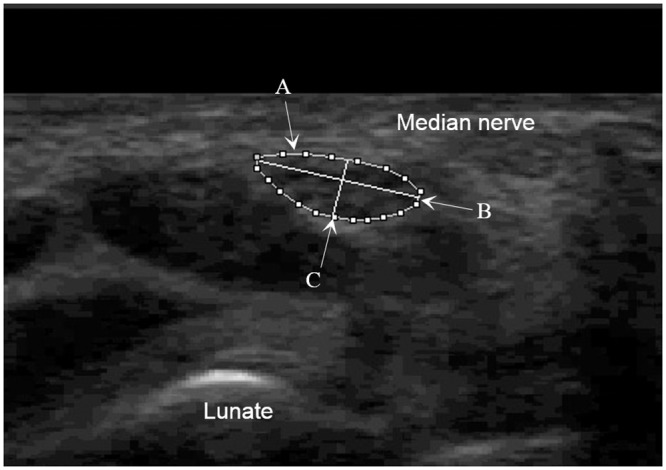
UltrasoundTransverse wrist ultrasound at the level of the wrist crease: outline of the median nerve cross-sectional area, the reference diagnostic method for carpal tunnel syndrome.
Source : Woo et al., PLoS ONE, 2016, figure 2 · CC BY
Provocative tests: diagnostic performance
The landmark MacDermid-Wessel 2004 meta-analysis (J Hand Ther, 19 studies appraised)⁸ and more recent reviews (Phys Ther 2023)⁹ show that no single test is sufficient; their combination improves diagnostic accuracy.| Clinical test | Sensitivity | Specificity | Level of evidence | Recommendation |
|---|---|---|---|---|
| Durkan carpal compression (direct pressure 30 sec) | 64-89 % | 33-83 % | Moderate evidence | Most sensitive test: first line |
| Phalen (wrist flexion 60 sec) | 46-80 % | 51-91 % | Moderate evidence | Useful in combination |
| Tinel (percussion over the median nerve) | 23-50 % | 59-94 % | Low | ⚠️ Unsuitable for ruling out the diagnosis |
| Two-point discrimination (sensory) | 33 % | 100 % | Moderate | Late-stage test (severity) |
| Abductor pollicis brevis strength | Variable | High if a deficit is present | High if atrophy is present | Sign of severity: surgical urgency |
| Boston Carpal Tunnel Questionnaire (BCTQ) | Very good correlation with EMG | Internationally validated | High | Reference PROM (Levine 1993) |
Further investigations
- Nerve conduction studies (NCS/electrodiagnostic testing) : objective gold standard, measuring the slowing of sensory and motor conduction of the median nerve at the wrist. 10-15 % false negatives in symptomatic patients (Padua 2016; Werner-Andary 2002)¹². Electrodiagnostic testing also allows the Bland 2000 severity classification (6 grades).
- Ultrasound : measurement of the cross-sectional area (CSA) of the median nerve at the pisiform. The pathological threshold is generally > 10-12 mm² (Roll 2023: normal reference 8.6 mm² ± 1.4)¹⁰. The comparison of nerve conduction studies versus ultrasound (Fowler 2014, n=85, independent validation) shows diagnostic equivalence for ultrasound, with the advantage of being non-invasive and less costly¹¹.
- MRI : reserved for atypical cases or suspected structural lesions (mass, anatomical anomaly).
🔄 CTS diagnostic algorithm: JOSPT 2019 (Erickson et al.)
Simplified workflow based on the Clinical Practice Guidelines (PMID 31039690)
Workflow adapted from the Clinical Practice Guidelines JOSPT 2019 (Erickson et al., PMID 31039690) and AAOS 2024. The decision rests on the combination of history + clinical tests + imaging, never on a single isolated test.
Differential diagnoses that must be ruled out ⚠️
- C6-C7 cervical radiculopathy : neck pain with radiation, dorsal paraesthesiae, altered reflexes. The Wainner 2003 cluster (Spine, n=82; PMID 12544957) combines 4 tests (Spurling, ULTT1, cervical distraction, cervical rotation < 60°): Sn 24 %, Sp 99 % if 4/4 positive¹³. Rubinstein 2007 (Eur Spine J; PMID 17013656) confirms the specificity of the cluster¹⁴.
- Thoracic outlet syndrome (TOS) : diffuse symptoms throughout the upper limb, frequent ulnar involvement, positive positional manoeuvres¹⁵.
- Pronator teres syndrome : compression of the median nerve in the proximal forearm, pain on palpation of pronator teres, weakness of the finger flexors¹.
- Polyneuropathy (diabetic, alcoholic, paraneoplastic): symmetrical bilateral involvement in a "glove and stocking" pattern.
- Double crush syndrome (Upton-McComas 1973 Lancet, Kane 2015 JAAOS): coexisting cervical AND carpal compression, of debated frequency but worth considering when treatment fails¹⁶¹⁷.
Should patients with carpal tunnel syndrome be classified, and what are the benefits?
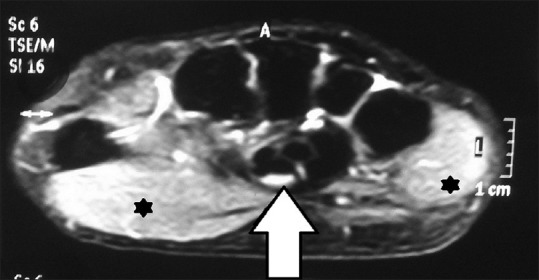
MRIAxial T2-weighted wrist MRI showing hyperintensity of the median nerve as well as oedema of the thenar and hypothenar muscles, in a case of carpal tunnel syndrome.
Source : Kasundra et al., Journal of neurosciences in rural practice, 2015, figure 3 · CC BY-NC-SA
| Bland grade | Severity | NCS | Recommended treatment approach |
|---|---|---|---|
| 0 | Very mild | Normal | Conservative (splint + education) |
| 1-2 | Mild | Segmental sensory slowing | Multimodal conservative care (Karjalainen 2023) |
| 3 | Moderate | Sensory + motor slowing | Intensive conservative care, injection if it fails |
| 4 | Severe | Reduced amplitude of the potentials | Surgical discussion |
| 5 | Very severe | No sensory response, motor response reduced | Surgery indicated |
| 6 | Extreme | Complete absence of response | Urgent surgery: guarded prognosis |
- ✅ Key points from the history : night-time paraesthesiae + Flick sign + median territory = strong clinical suspicion.
- 🎯 Durkan compression is the most sensitive provocative test (~80 %); Tinel unreliable (Sn < 50 %).
- 📊 NCS = gold standard (10-15 % false negatives); ultrasound (CSA > 10 mm²) is an equivalent and less invasive alternative.
- 📈 The Bland 2000 classification guides treatment: grade 0-3 conservative, grade 4-6 surgical.
- ⚠️ The Wainner cluster (Spurling + ULTT1 + distraction + rotation < 60°) rules out C6-C7 radiculopathy (Sp 99 % if 4/4).
Bibliography
- Padua L, Coraci D, Erra C, et al. Carpal tunnel syndrome: clinical features, diagnosis, and management. Lancet Neurol. 2016;15(12):1273-1284. PMID 27751557.
- Erickson M, Lawrence M, Jansen CWS, Coker D, Amadio P, Cleary C. Hand Pain and Sensory Deficits: Carpal Tunnel Syndrome. Clinical Practice Guidelines linked to the ICF. J Orthop Sports Phys Ther. 2019;49(5):CPG1-CPG85. PMID 31039690.
- Sevy JO, Sina RE, Varacallo M. Carpal Tunnel Syndrome. StatPearls [Internet]. StatPearls Publishing; 2024. NBK448179.
- Bland JD. Carpal tunnel syndrome. BMJ. 2007;335(7615):343-346. PMID 17703044.
- Amirfeyz R, Gozzard C, Leslie IJ. Hand elevation test for assessment of carpal tunnel syndrome. J Hand Surg Br. 2005;30(4):361-364. PMID 15951075.
- Pourmemari MH, Shiri R. Diabetes as a risk factor for carpal tunnel syndrome: a systematic review and meta-analysis. Diabet Med. 2016;33(1):10-16. PMID 26173490.
- Hassan A, Beumer A, Kuijer PPFM, van der Molen HF. Work-relatedness of carpal tunnel syndrome: SR with meta-analysis and GRADE. Health Sci Rep. 2022;5(6):e888. PMC9629628.
- MacDermid JC, Wessel J. Clinical diagnosis of carpal tunnel syndrome: a systematic review. J Hand Ther. 2004;17(2):309-319. PMID 15162113.
- Wipperman J, Goerl K. Carpal Tunnel Syndrome: Diagnosis and Management. Am Fam Physician. 2016;94(12):993-999. PMID 28075090.
- Roll SC, Takata SC, Yao B, Kysh L, Mack WJ. Sonographic Reference Values for Median Nerve Cross-sectional Area: A Meta-analysis. J Diagn Med Sonogr. 2023;39(5):492-506. DOI 10.1177/87564793231176009.
- Fowler JR, Munsch M, Tosti R, Hagberg WC, Imbriglia JE. Comparison of ultrasound and electrodiagnostic testing for diagnosis of carpal tunnel syndrome. J Bone Joint Surg Am. 2014;96(17):e148. PMID 25187592.
- Werner RA, Andary M. Carpal tunnel syndrome: pathophysiology and clinical neurophysiology. Clin Neurophysiol. 2002;113(9):1373-1381. PMID 12169318.
- Wainner RS, Fritz JM, Irrgang JJ, Boninger ML, Delitto A, Allison S. Reliability and diagnostic accuracy of the clinical examination and patient self-report measures for cervical radiculopathy. Spine. 2003;28(1):52-62. PMID 12544957.
- Rubinstein SM, Pool JJ, van Tulder MW, Riphagen II, de Vet HC. A systematic review of the diagnostic accuracy of provocative tests of the neck for diagnosing cervical radiculopathy. Eur Spine J. 2007;16(3):307-319. PMID 17013656.
- Laulan J, Fouquet B, Rodaix C, Jauffret P, Roquelaure Y, Descatha A. Thoracic outlet syndrome. J Occup Rehabil. 2011;21(3):366-373. PMID 21193950.
- Upton ARM, McComas AJ. The double crush in nerve-entrapment syndromes. Lancet. 1973;2(7825):359-362. PMID 4124532.
- Kane PM, Daniels AH, Akelman E. Double Crush Syndrome. J Am Acad Orthop Surg. 2015;23(9):558-562. PMID 26306807.
- Bland JD. A neurophysiological grading scale for carpal tunnel syndrome. Muscle Nerve. 2000;23(8):1280-1283. PMID 10918269.
Which treatment strategies are most effective for carpal tunnel syndrome?
Where do you start? What is the recommended hierarchy of interventions?
For CTS cases that are mild to moderate (Bland 0-3), conservative treatment is universally recommended as first line by all the major guidelines¹²: Erickson 2019 JOSPT CPG (PMID 31039690), AAOS 2024, the European HANDGUIDE Huisstede 2014³. Hierarchy of initial interventions (Erickson 2019, level A) ¹ :- Wrist splint in neutral position, worn at night 🛏️: the reference intervention for night-time symptoms. The Cochrane review Karjalainen 2023 (CD010003, PMID 36848651, 29 RCTs, n=1,937)⁴ confirms an overall improvement OR 3.86 (95 % CI 2.29-6.51) in the short term versus no treatment. The splint minimises wrist flexion during sleep and lowers intracanal pressure from ~30 to ~15 mmHg⁵.
- Patient education 🧑🏫: explanation of the condition, importance of adherence, targeted ergonomic changes at work and at home¹.
- Ergonomic changes : workstation adjustment, ergonomic keyboards and mice, regular breaks. Moderate evidence, but logical in secondary prevention⁶.
- Thenar atrophy or clinical motor deficit (abductor pollicis brevis)
- Electrodiagnostic severity Bland ≥ 4-5
- Failure of 3-6 months of well-conducted conservative treatment
- Informed patient preference
What is the place of exercise, and is any one approach superior?
Therapeutic exercise is a central component of conservative management, but no single modality has shown clear superiority⁸. Nerve and tendon gliding exercises 🤸: the Ballestero-Pérez 2021 meta-analysis (J Orthop Sports Phys Ther, 10 RCTs, n=506)⁸ shows significant positive short-term effects on pain, function and electrodiagnostic parameters in mild to moderate CTS. The proposed mechanism: improved excursion of the median nerve (~9-12 mm in wrist flexion-extension) and reduced perineural adhesions⁹.Manual therapies and technologies: how effective are they really?
- Manual therapy 🖐️: the Wei 2022 meta-analysis (Int Orthop, 11 RCTs, n=617; PMID 34862562)¹⁰ confirms a significant short-term effect on pain and function. The landmark Fernandez-de-las-Penas 2015 trial (J Pain, n=120) and its 2017 follow-up (JOSPT, PMID 28158963)¹¹ compared manual therapy versus surgery : equivalence at 1, 3, 4 and 11 years for function and pain, a major finding that repositions the place of physiotherapy in mild to moderate CTS.
- Therapeutic ultrasound 🔊: the Cochrane review Page 2013 (CD009601, PMID 23543580)¹² reports small to moderate short-term benefits. The recent Domínguez-Navarro 2023 meta-analysis (PMC9980503) confirms a significant improvement in distal motor latency¹³.
- Low-level laser therapy (LLLT) ✨: the recent 2025 meta-analysis (Lasers Med Sci, PMID 39776290)¹⁴ demonstrates significant efficacy on pain, grip strength and function in mild to moderate CTS. Photobiomodulation through an anti-inflammatory effect and stimulation of the microcirculation.
- Extracorporeal shockwave therapy (ESWT) : the Wu 2023 meta-analysis (J Clin Med, PMID 38068415, 11 RCTs)¹⁵ shows safe and significant medium-term efficacy (3-6 months) on pain and function.
- Mobilisation of the carpal bones : included within manual therapy, moderate level of evidence (Wei 2022)¹⁰.
| Intervention | Proposed mechanism | Level of evidence | Short-term effect | Long-term effect |
|---|---|---|---|---|
| Neutral night splint | ↓ intracanal pressure | Moderate (Karjalainen 2023) | OR 3.86 (overall improvement) | Reduced but maintained |
| Nerve/tendon gliding | ↑ median nerve excursion | Moderate (Ballestero-Pérez 2021) | Δ pain −2.5 NRS; function +20 % | Maintained if continued |
| Manual therapy (carpus, cervical spine) | Neurodynamic modulation | Moderate (Wei 2022) | Significant Δ pain | Equivalent to surgery at 11 years (Fernandez 2017) |
| Therapeutic ultrasound | Microcirculation, anti-inflam. | Moderate (Cochrane Page 2013) | Low to moderate | Uncertain |
| LLLT (photobiomodulation) | Anti-inflammatory | Moderate (MA 2025) | Δ pain and function | Limited data |
| ESWT (shockwave) | Tissue regeneration | Moderate (Wu 2023) | Δ pain 30-40 % | Maintained at 6 months |
| Corticosteroid injection | Local anti-inflammatory | High (Chesterton 2018 INSTINCTS) | Superior to splint at 6 weeks | Effect ↓ at 6 months |
| Surgery (TCL release) | Mechanical decompression | High (Jarvik 2009 Lancet) | Excellent | Excellent (90-95 % at 5 years) |
Beyond the physical: how do you educate the patient and address psychological factors?
Modern management of CTS is built on the biopsychosocial model :- In-depth therapeutic education 🧠: explanation of the mechanisms (dynamic compression, reversible ischaemia), reassurance, realistic expectations. Pain Neuroscience Education (Louw 2011 APMR, PMID 22133255)¹⁷ has shown its effectiveness in chronic musculoskeletal pain and may be useful in chronic CTS with a central sensitisation component.
- Central sensitisation in CTS : Fernandez-de-las-Penas 2009 (Brain, PMID 19336461)¹⁸ demonstrated widespread, bilateral mechanical hypersensitivity in women with unilateral CTS, suggesting central nociplastic processes. A 2020 review (F1000Research, PMID 32595941) updates the clinical implications¹⁹.
- Yellow flags : catastrophising (PCS Sullivan 1995), kinesiophobia (TSK Vlaeyen 1995, PMID 8657437)²⁰, anxiety, depression: major predictors of chronicity, to be screened for systematically.
- ✅ First line Mild to moderate CTS (Bland 0-3): neutral night splint (Karjalainen 2023 Cochrane, OR 3.86) + education + ergonomics.
- 🤸 Nerve/tendon gliding (Ballestero-Pérez 2021) is effective in the short term: no protocol is superior, and adherence counts for more than the choice.
- 🖐️ Multimodal manual therapy (Wei 2022): equivalent to surgery for mild forms at 11 years (Fernandez-de-las-Penas 2017).
- 💉 Corticosteroid injections : superior at 6 weeks but the effect fades by 6 months (INSTINCTS Chesterton 2018), with no change to the natural history.
- ⚙️ Surgery : indicated for thenar atrophy, Bland ≥ 4, or failure at 3-6 months (Jarvik 2009 Lancet).
- 🧠 Psychosocial factors (catastrophising, kinesiophobia, central sensitisation Fernandez-de-las-Penas 2009) must be screened for and addressed.
Bibliography
- Erickson M, Lawrence M, Jansen CWS, Coker D, Amadio P, Cleary C. Hand Pain and Sensory Deficits: Carpal Tunnel Syndrome. Clinical Practice Guidelines linked to the ICF. J Orthop Sports Phys Ther. 2019;49(5):CPG1-CPG85. PMID 31039690.
- American Academy of Orthopaedic Surgeons. Management of Carpal Tunnel Syndrome. Evidence-Based Clinical Practice Guideline. J Bone Joint Surg Am. 2016;98(20):1750-1754. PMID 27869627. AAOS 2024 update (cts-cpg.pdf).
- Huisstede BM, Fridén J, Coert JH, Hoogvliet P; European HANDGUIDE Group. Carpal tunnel syndrome: HANDGUIDE consensus. Arch Phys Med Rehabil. 2014;95(12):2253-2263. PMID 25127999.
- Karjalainen TV, Lusa V, Page MJ, O'Connor D, Massy-Westropp N, Peters SE. Splinting for carpal tunnel syndrome. Cochrane Database Syst Rev. 2023;2(2):CD010003. PMID 36848651.
- Werner RA, Andary M. Carpal tunnel syndrome: pathophysiology and clinical neurophysiology. Clin Neurophysiol. 2002;113(9):1373-1381. PMID 12169318.
- Newington L, Harris EC, Walker-Bone K. Carpal tunnel syndrome and work. Best Pract Res Clin Rheumatol. 2015;29(3):440-453. PMID 26612240.
- Jarvik JG, Comstock BA, Kliot M, et al. Surgery versus non-surgical therapy for carpal tunnel syndrome: a randomised parallel-group trial. Lancet. 2009;374(9695):1074-1081. PMID 19782873.
- Ballestero-Pérez R, Plaza-Manzano G, Urraca-Gesto A, et al. Short-term Effects of Neurodynamic Techniques for Treating Carpal Tunnel Syndrome: A Systematic Review With Meta-analysis. J Orthop Sports Phys Ther. 2021;51(12):566-580. DOI 10.2519/jospt.2021.10533.
- Coppieters MW, Butler DS. Do 'sliders' slide and 'tensioners' tension? An analysis of neurodynamic techniques. Man Ther. 2008;13(3):213-221. PMID 17398140.
- Jiménez-Del-Barrio S, Cadellans-Arróniz A, Ceballos-Laita L, et al. The effectiveness of manual therapy on pain, physical function, and nerve conduction studies in carpal tunnel syndrome patients: a systematic review and meta-analysis. Int Orthop. 2022;46(2):301-312. PMID 34862562.
- Fernández-de-las-Peñas C, Cleland JA, Palacios-Ceña M, Fuensalida-Novo S, Pareja JA, Alonso-Blanco C. The Effectiveness of Manual Therapy Versus Surgery on Self-reported Function, Cervical ROM, and Pinch Grip Force in Carpal Tunnel Syndrome: A RCT. J Orthop Sports Phys Ther. 2017;47(3):151-161. PMID 28158963.
- Page MJ, O'Connor D, Pitt V, Massy-Westropp N. Therapeutic ultrasound for carpal tunnel syndrome. Cochrane Database Syst Rev. 2013;(3):CD009601. PMID 23543580.
- Domínguez-Navarro F, Casaña-Granell J, Calatayud J, et al. Ultrasound improves motor distal latency on patients with carpal tunnel syndrome: SR & MA. BMC Musculoskelet Disord. 2023. PMC9980503.
- Photobiomodulation in carpal tunnel syndrome with pain, strength, and functionality analysis: systematic review with meta-analysis. Lasers Med Sci. 2025. PMID 39776290.
- Wu YT, Ke MJ, Ho TY, et al. Effects of Extracorporeal Shock Wave Therapy in Patients with Mild-to-Moderate Carpal Tunnel Syndrome: An Updated SR & MA. J Clin Med. 2023;12(23):7363. PMID 38068415.
- Chesterton LS, Blagojevic-Bucknall M, Burton C, et al. The clinical and cost-effectiveness of corticosteroid injection versus night splints for carpal tunnel syndrome (INSTINCTS trial): an open-label, parallel group, randomised controlled trial. Lancet. 2018;392(10156):1423-1433. PMC6196880.
- Louw A, Diener I, Butler DS, Puentedura EJ. The effect of neuroscience education on pain, disability, anxiety, and stress in chronic musculoskeletal pain. Arch Phys Med Rehabil. 2011;92(12):2041-2056. PMID 22133255.
- Fernández-de-las-Peñas C, de la Llave-Rincón AI, Fernández-Carnero J, Cuadrado ML, Arendt-Nielsen L, Pareja JA. Bilateral widespread mechanical pain sensitivity in carpal tunnel syndrome: evidence of central processing in unilateral neuropathy. Brain. 2009;132(Pt 6):1472-1479. PMID 19336461.
- Fernández-de-las-Peñas C, Cleland J, Palacios-Ceña M, Fuensalida-Novo S, Pareja JA, Alonso-Blanco C. Understanding central sensitization for advances in management of carpal tunnel syndrome. F1000Res. 2020;9:F1000 Faculty Rev-605. PMID 32595941.
- Vlaeyen JWS, Kole-Snijders AMJ, Boeren RGB, van Eek H. Fear of movement/(re)injury in chronic low back pain and its relation to behavioral performance. Pain. 1995;62(3):363-372. PMID 8657437.
How can lasting recovery be secured and recurrence of carpal tunnel syndrome prevented?
How do you make the patient an active partner in their own recovery through self-management?
Patient empowerment is the key to preventing recurrence of CTS. 🧠 The physiotherapist's role is changing: they become a "coach" and educator, no longer the sole operator of a passive treatment. The Erickson 2019 guidelines (JOSPT, PMID 31039690)¹ and AAOS 2024² place education and self-management at level A. Essential components of a self-management programme :- Night splint adherence 🛏️: the Cochrane review Karjalainen 2023 (PMID 36848651, n=1,937)³ shows that the effect depends directly on adherence. A well-tolerated splint worn every night is more effective than a perfect splint worn occasionally.
- Home exercises 🤸: the standard protocol, which includes nerve and tendon gliding (Ballestero-Pérez 2021, PMID confirmed via DOI)⁴, takes 5-10 minutes, 2-3 times a day. Progression is gradual, without reproducing pain.
- Ergonomic changes at work and at home: analysis of wrist flexion/extension postures, regular breaks, task rotation, keyboard and mouse adjustment⁵.
- Identifying and managing triggering activities : prolonged driving, cycling, sport (weight training with the wrists extended), musical instruments, all to be adapted rather than necessarily stopped¹.
- Managing metabolic factors : glycaemic control in people with diabetes (Pourmemari 2016)⁶, gradual weight loss if BMI > 30 (Shiri 2015)⁷, where the effect on symptoms can be substantial.
When and how should you plan a safe return to sport and other activities?
Return to work, sport or leisure activities must be gradual and guided by objective criteria, in order to avoid recurrence. 💪 Premature return to repetitive loading or to provocative postures is a major risk factor for relapse¹. Return-to-activity criteria (adapted from Erickson 2019 and the Ardern 2016 RTS framework)⁸:- Resolution of night-time paraesthesiae and of night-time waking
- BCTQ-SSS (Boston Carpal Tunnel Questionnaire - Symptom Severity Scale) < 2 or improvement ≥ MCID 0.5-1 point (López-de-Uralde-Villanueva 2023, PMID 37582474)⁹
- Grip strength on the Jamar dynamometer ≥ 90 % of the unaffected side (3 trials, standardised position)¹⁰
- Pulp-to-pulp pinch strength and abductor pollicis brevis function normal
- Sensation normalised (Semmes-Weinstein monofilament test, two-point discrimination)
- No recurrence during a functional test specific to the patient's sport or occupation
- Weeks 0-4 : night splint + home exercises + activities without wrist loading. Weekly monitoring of PROMs.
- Weeks 4-8 : gradual reintroduction of work activities with breaks and optimised ergonomics. For athletes: general conditioning exercises.
- Weeks 8-12 : reintroduction of specific loading (cycling, weight training, musical instrument). Gradual increase in volume and intensity.
- Beyond that : maintenance of preventive exercises 2-3×/week, monitoring of risk factors (workstation, comorbidities).
Secondary prevention and workplace modifications
The Hassan 2022 meta-analysis (Health Sci Rep, PMC9629628)¹¹ identifies the modifiable occupational factors with a level of evidence of GRADE high :- Hand-arm vibration (vibrating tools, jackhammers)
- Forceful repetitive movements (gripping, poor ergonomics)
- Prolonged extreme postures of the wrist
- Application of high manual force
- Adjustment of the computer workstation (neutral keyboard, ergonomic mouse, wrist rest)
- Scheduled breaks (adapted 20-20-20 rule: every 20 minutes, 20 seconds of pause, micro-stretches)
- Task rotation to spread the loading
- Anti-vibration tools if the occupation is exposed
- Training in forearm self-massage and neural self-mobilisation
- 🛏️ Night splint adherence is the key factor in success: the effect depends on regular wear (Karjalainen 2023 Cochrane).
- 🤸 Home exercises (nerve gliding 5-10 min, 2-3×/day): regularity matters more than the protocol.
- 📊 Return criteria : BCTQ-SSS < 2, grip strength ≥ 90 % of the unaffected side, resolution of night-time paraesthesiae.
- 👷 Secondary prevention : ergonomics, breaks, task rotation, management of metabolic factors (diabetes, obesity).
- 📈 The progression must be gradual (weeks 0-4 / 4-8 / 8-12 / beyond), guided by PROMs and individual tolerance.
Bibliography
- Erickson M, Lawrence M, Jansen CWS, Coker D, Amadio P, Cleary C. Hand Pain and Sensory Deficits: Carpal Tunnel Syndrome. Clinical Practice Guidelines linked to the ICF. J Orthop Sports Phys Ther. 2019;49(5):CPG1-CPG85. PMID 31039690.
- American Academy of Orthopaedic Surgeons. Management of Carpal Tunnel Syndrome - Evidence-Based Clinical Practice Guideline. AAOS, 2024.
- Karjalainen TV, Lusa V, Page MJ, O'Connor D, Massy-Westropp N, Peters SE. Splinting for carpal tunnel syndrome. Cochrane Database Syst Rev. 2023;2(2):CD010003. PMID 36848651.
- Ballestero-Pérez R, Plaza-Manzano G, Urraca-Gesto A, et al. Short-term Effects of Neurodynamic Techniques for Carpal Tunnel Syndrome: A SR With Meta-analysis. J Orthop Sports Phys Ther. 2021;51(12):566-580. DOI 10.2519/jospt.2021.10533.
- Newington L, Harris EC, Walker-Bone K. Carpal tunnel syndrome and work. Best Pract Res Clin Rheumatol. 2015;29(3):440-453. PMID 26612240.
- Pourmemari MH, Shiri R. Diabetes as a risk factor for carpal tunnel syndrome: a systematic review and meta-analysis. Diabet Med. 2016;33(1):10-16. PMID 26173490.
- Shiri R, Pourmemari MH, Falah-Hassani K, Viikari-Juntura E. The effect of excess body mass on the risk of carpal tunnel syndrome: a meta-analysis of 58 studies. Obes Rev. 2015;16(12):1094-1104. PMID 26395787.
- Ardern CL, Glasgow P, Schneiders A, et al. 2016 Consensus statement on return to sport. Br J Sports Med. 2016;50(14):853-864. PMID 27226389.
- López-de-Uralde-Villanueva I, Fernández-de-Las-Peñas C, Cleland JA, et al. Minimal Clinically Important Differences in Hand Pain Intensity (Numerical Pain Rate Scale) and Related-Function (Boston Carpal Tunnel Questionnaire) in Women With Carpal Tunnel Syndrome. Arch Phys Med Rehabil. 2024;105(1):67-74. PMID 37582474.
- Graham B. The value added by electrodiagnostic testing in the diagnosis of carpal tunnel syndrome. J Bone Joint Surg Am. 2008;90(12):2587-2593. PMID 19047703.
- Hassan A, Beumer A, Kuijer PPFM, van der Molen HF. Work-relatedness of carpal tunnel syndrome: SR with meta-analysis and GRADE. Health Sci Rep. 2022;5(6):e888. PMC9629628.
What do real-world case studies teach us about carpal tunnel syndrome?
Analysis of a classic case: from assessment to resolution
A typical case of CTS involves a 50-year-old woman working in an office, with no major comorbidity, who presents with night-time paraesthesiae of the first three fingers, waking her several times a night for the past 4 months. The Flick sign is positive. Examination shows a positive Phalen at 30 sec, a negative Tinel and a positive Durkan carpal compression. There is no thenar atrophy. Sensation is preserved. The BCTQ-SSS is 2.8 (moderately severe). Treatment strategy over 12 weeks (based on the Erickson 2019 JOSPT CPG)¹:- W0-W2 : education, wrist splint in neutral position worn every night (Karjalainen 2023 Cochrane, OR 3.86)², ergonomic changes at the workstation (neutral keyboard, ergonomic mouse, breaks), nerve and tendon gliding exercises 5 min × 3/day (Ballestero-Pérez 2021)³.
- S2-S6 : addition of manual therapy (mobilisation of the carpal bones + cervicothoracic spine, after Fernandez-de-las-Penas 2017)⁴ once a week. Weekly BCTQ monitoring.
- W6-W10 : if pain relief plateaus, LLLT or ESWT may be added (Wu 2023, Lasers Med Sci 2025)⁵⁶.
- W10-W12 : if progress is good, start the return-to-activity phase (strength ≥ 90 % of the unaffected side, BCTQ-SSS < 2). Otherwise, discuss a surgical opinion.
The diagnostic challenge: when carpal tunnel syndrome mimics (or conceals) another condition
The C6-C7 cervical radiculopathy is the main diagnostic pitfall. 🧐 A 58-year-old patient with radiating neck pain, paraesthesiae of the thumb and index finger and a positive Phalen test presents a mixed picture. The Wainner 2003 cluster (Spurling + ULTT1 + cervical distraction + cervical rotation < 60°; PMID 12544957)⁹ with 4/4 positive gives Sp 99 % for cervical radiculopathy and should then prompt cervical MRI rather than treatment of the wrist alone. The "double crush syndrome" is a concept proposed by Upton-McComas 1973 (Lancet, PMID 4124532)¹⁰: a proximal nerve compression (cervical, plexus, thoracic outlet) makes the nerve more vulnerable to a second, more distal compression (carpal tunnel). The Kane 2015 review (JAAOS, PMID 26306807)¹¹ recalls that this concept remains debated pathophysiologically but is clinically useful: any patient not responding to well-conducted treatment should undergo a full cervical and neurodynamic examination. Russell 2008 (Chiropr Osteopat, PMID 18426564)¹² proposes a practical framework for analysis.🚦 Differential table: CTS versus cervical radiculopathy
Source: Wainner 2003 + Padua 2016 + Rubinstein 2007, Sp 99 % for the Wainner cluster if 4/4 positive
Sources: Wainner 2003 (PMID 12544957), Rubinstein 2007 (PMID 17013656), Padua 2016 (PMID 27751557).
Study of a complex case: anatomical variants and rare causes
Beyond the classic presentations, some atypical cases call for imaging to identify structural causes. ⚠️ Common anatomical variants :- Bifid median nerve (Lanz variant): prevalence of 8.6 % in the Walker 2014 cohort (n=1,026 wrists)¹³. An Asghar 2022 meta-analysis (Clin Anat)¹⁴ confirms the association with an increased risk of CTS. Clinical implications: risk of injury during injection or surgery without ultrasound guidance.
- Persistent median artery (PMA) : prevalence of 3.7 % in the same cohort¹³; the Solewski 2021 meta-analysis (Clin Anat, n=10,394; PMID 34371525)¹⁵ reports an overall prevalence of 22 %, rising over recent decades.
- Intracarpal lipoma : Kerimoglu et al. (2015, Open Access Maced J Med Sci, PMID 26664552)¹⁶: palpable mass, ultrasound + MRI, surgical excision.
- Schwannoma of the median nerve : Strickland (several PMIDs), Tahririan 2023 (Int J Surg Case Rep, PMC10692475): a differential diagnosis worth knowing.
- Intracanal ganglion : occult aetiologies, value of high-frequency diagnostic ultrasound.
- Pigmented villonodular tenosynovitis (PVNS) : Chen WS and Chen L 1990 (J Formos Med Assoc, PMID 1973710): a rare cause mimicking CTS.
📐 GRADE / Oxford CEBM pyramid: where does the evidence on CTS sit?
Strength of evidence decreasing from the top (meta-analyses) to the bottom (case reports)
GRADE / Oxford CEBM hierarchy. The length of the coloured bar on the right illustrates the relative strength of evidence. Practical implication: when an appealing case report and a meta-analysis diverge, the decision must follow the meta-analysis. Case reports generate hypotheses, flag rare presentations or illustrate a line of reasoning; they never demonstrate efficacy.
- Typical case : 50-year-old woman, night-time paraesthesiae, Flick sign + Durkan + → 12-week protocol (night splint + nerve gliding + manual therapy + ergonomics), resolution in ~50 % of cases (Burton 2016).
- Wainner cluster (4 tests): Sp 99 % for C6-C7 cervical radiculopathy if 4/4 positive → do not miss this differential diagnosis.
- Double crush syndrome (Upton-McComas 1973, Kane 2015): to be considered when well-conducted treatment fails.
- Anatomical variants worth knowing: bifid median nerve (8.6 % Walker 2014), persistent median artery (3.7-22 % Solewski 2021).
- Atypical cases (case reports) = GRADE level 5. They illustrate, they never prove anything. Decisions follow the meta-analyses (level 1a).
Bibliography
- Erickson M, Lawrence M, Jansen CWS, et al. Hand Pain and Sensory Deficits: CTS. CPG. J Orthop Sports Phys Ther. 2019;49(5):CPG1-CPG85. PMID 31039690.
- Karjalainen TV, Lusa V, Page MJ, et al. Splinting for carpal tunnel syndrome. Cochrane Database Syst Rev. 2023;2(2):CD010003. PMID 36848651.
- Ballestero-Pérez R, Plaza-Manzano G, Urraca-Gesto A, et al. Short-term Effects of Neurodynamic Techniques for CTS: SR With Meta-analysis. J Orthop Sports Phys Ther. 2021;51(12):566-580. DOI 10.2519/jospt.2021.10533.
- Fernández-de-las-Peñas C, Cleland JA, Palacios-Ceña M, et al. The Effectiveness of Manual Therapy Versus Surgery on Self-reported Function, Cervical ROM, and Pinch Grip Force in CTS: A RCT. J Orthop Sports Phys Ther. 2017;47(3):151-161. PMID 28158963.
- Wu YT, Ke MJ, Ho TY, et al. ESWT in CTS: Updated SR & MA. J Clin Med. 2023;12(23):7363. PMID 38068415.
- Photobiomodulation in CTS with pain, strength, and functionality analysis: SR/MA. Lasers Med Sci. 2025. PMID 39776290.
- Burton CL, Chesterton LS, Chen Y, van der Windt DA. Clinical Course and Prognostic Factors in Conservatively Managed CTS: A Systematic Review. Arch Phys Med Rehabil. 2016;97(5):836-852.e1. PMID 26440776.
- Chesterton LS, Blagojevic-Bucknall M, Burton C, et al. INSTINCTS trial: corticosteroid injection vs night splints for CTS. Lancet. 2018;392(10156):1423-1433. PMC6196880.
- Wainner RS, Fritz JM, Irrgang JJ, Boninger ML, Delitto A, Allison S. Reliability and diagnostic accuracy of the clinical examination and patient self-report measures for cervical radiculopathy. Spine. 2003;28(1):52-62. PMID 12544957.
- Upton ARM, McComas AJ. The double crush in nerve-entrapment syndromes. Lancet. 1973;2(7825):359-362. PMID 4124532.
- Kane PM, Daniels AH, Akelman E. Double Crush Syndrome. J Am Acad Orthop Surg. 2015;23(9):558-562. PMID 26306807.
- Russell BS. CTS and the "double crush" hypothesis: a review and implications for chiropractic. Chiropr Osteopat. 2008;16:2. PMID 18426564.
- Walker FO, Cartwright MS, Blocker JN, et al. Prevalence of bifid median nerves and persistent median arteries: a sonographic assessment in poultry processors. Muscle Nerve. 2013;48(4):539-544. PMC3836559.
- Asghar A, Naaz S, Rani M, et al. Bifid median nerve as an anatomical risk factor for carpal tunnel syndrome: A meta-analysis. Clin Anat. 2022. DOI 10.1002/ca.23900.
- Solewski B, Lis M, Pękala JR, et al. The persistent median artery and its vascular patterns: A meta-analysis of 10,394 subjects. Clin Anat. 2021;34(8):1173-1185. PMID 34371525.
- Sbai MA, Benzarti S, Msek H, Boussen M, Khorbi A. Carpal tunnel syndrome caused by lipoma: a case report. Pan Afr Med J. 2015;22:51. PMID 26664552.
- Padua L, Coraci D, Erra C, et al. Carpal tunnel syndrome: clinical features, diagnosis, and management. Lancet Neurol. 2016;15(12):1273-1284. PMID 27751557.
How do you apply these recommendations concretely in your practice?
When and to which other health professionals should you refer?
Interprofessional collaboration is a pillar of CTS management. The WHO 2010 (Framework for Action on Interprofessional Education)¹ and the Cochrane review Reeves 2017 (CD000072, PMID 28639262)² confirm that it improves quality of care and patient satisfaction. Identifying red flags is the first non-negotiable step. The IFOMPT Finucane 2020 framework (JOSPT, PMID 32438853)³ addresses the spine, but its methodology can be transposed to the upper limb. For CTS, the specific red flags are:🚩 Red flags specific to carpal tunnel syndrome
- Visible thenar atrophy or marked weakness of abductor pollicis brevis → early surgical referral (Padua 2016)⁴
- Progressive motor deficit over a few weeks (Bland ≥ 5) → urgent decompression
- Palpable mass at the wrist, local inflammatory signs, warmth → suspected structural lesion (ganglion, lipoma, schwannoma, PVNS), so ultrasound in every case
- Symmetrical bilateral symptoms with proximal spread (glove pattern) → suspected diabetic, alcoholic or paraneoplastic polyneuropathy, so blood tests + full electrodiagnostic testing
- Recent history of trauma to the wrist with major oedema or disproportionate pain → occult fracture, compartment syndrome, compressive haematoma
- History of cancer + persistent localised pain → MRI in every case to rule out bone or soft-tissue metastasis
- Unexplained mechanical night pain, unexplained weight loss > 5 % in 6 months, persistent fever, night sweats → systemic work-up essential (medical referral)
- Complete failure after 3-6 months of well-conducted conservative treatment → diagnostic reappraisal + MRI or ultrasound, surgical discussion
⚠️ Any red flag → prompt medical referral (GP, hand surgeon, neurologist, rheumatologist, even oncologist depending on the context).
- Occupational physician / ergonomist : workstation analysis, collective and individual adjustments, secondary prevention (Newington 2015, Hassan 2022)⁹¹⁰.
- GP / neurologist : request for electrodiagnostic testing, imaging work-up, monitoring of comorbidities (diabetes, hypothyroidism).
- Hand surgeon / orthopaedic surgeon : surgical opinion if Bland severity ≥ 4, thenar atrophy, or failure at 3-6 months (Jarvik 2009 Lancet)¹¹.
- Endocrinologist : stabilisation of poorly controlled diabetes, thyroid management.
- Psychologist (CBT) or pain therapist : if yellow flags persist (catastrophising, severe kinesiophobia, depression).
- Rehabilitation physician : coordination of complex care, ultrasound-guided corticosteroid injection where indicated (Chesterton 2018 INSTINCTS)¹².
How do you measure outcomes and overcome the barriers to implementation?
Standardised outcome measurement is essential. 📈 The Erickson 2019 CPGs (JOSPT)⁴ systematically recommend:- Boston Carpal Tunnel Questionnaire (BCTQ) from Levine 1993 (J Bone Joint Surg Am, PMID 8245050)¹³, the international reference tool, with 2 subscales: Symptom Severity Scale (SSS, 11 items) and Functional Status Scale (FSS, 8 items), each scored 1-5. MCID 0.5-1 point (Kim 2013, PMID 22457249; López-de-Uralde-Villanueva 2023, specific to women, PMID 37582474)¹⁴¹⁵.
- QuickDASH (11 items, score 0-100), Beaton 2005 (PMID 15866967), Mintken 2009 (PMID 19297202) MCID 8 points in musculoskeletal disorders¹⁶.
- PRWE / PRWHE (Patient-Rated Wrist / Wrist-and-Hand Evaluation), MacDermid 1998 (PMID 9840793)¹⁷, specific to the wrist.
- Numerical rating scale (NPRS) for pain at rest, on activity and at night, MCID 1-2 points.
- Grip strength on the Jamar dynamometer (3 trials, standardised position), pinch strength on the pinch meter.
- Psychosocial scales where indicated : TSK (kinesiophobia, MCID 4 points), PCS (catastrophising), HADS (anxiety/depression).
- Lack of time (the most frequently cited barrier)
- Lack of skills in critical appraisal and synthesis
- Limited access to databases and to full text
- Resistance to change and excessive confidence in personal experience
- Patient expectations of quick passive solutions
- Clinical champions (Miech 2018, SAGE Open Med, PMID 29796266)¹⁹: leaders within a team who promote and support the adoption of new practices.
- CFIR framework (Damschroder 2009, Implement Sci, PMID 19664226)²⁰: the Consolidated Framework for Implementation Research, which structures the analysis of factors influencing implementation.
- Audit and feedback (Ivers 2012, Cochrane CD000259, PMID 22696318)²¹: small consistent improvements in adherence to recommendations.
- Integrating PROMs into the consultation workflow: Gibbons 2021 (Cochrane CD011589, PMID 34637526)²² confirms that systematically feeding PROMs back to clinicians and patients improves outcomes.
- Targeted continuing education on the recent guidelines (Erickson 2019, AAOS 2024, Karjalainen 2023).
- 🚩 CTS red flags : thenar atrophy, motor deficit, palpable mass, symmetrical bilateral symptoms, unexplained mechanical night pain, systemic signs → prompt medical referral.
- 🟡 Yellow flags (catastrophising, kinesiophobia, depression) predict chronicity (Nicholas 2011) and should be assessed systematically.
- 📋 Essential PROMs : BCTQ (Levine 1993, MCID 0.5-1), QuickDASH (Mintken 2009, MCID 8), Jamar grip strength: level A in the Erickson 2019 CPGs.
- 🤝 Interprofessional collaboration : occupational physician, hand surgeon, endocrinologist, neurologist, CBT psychologist depending on the profile.
- 💡 Overcoming barriers to EBP : clinical champions (Miech 2018), audit & feedback (Ivers 2012 Cochrane), integration of PROMs (Gibbons 2021 Cochrane), continuing education.
Bibliography
- World Health Organization. Framework for Action on Interprofessional Education & Collaborative Practice. WHO/HRH/HPN/10.3, 2010. WHO 2010.
- Reeves S, Pelone F, Harrison R, Goldman J, Zwarenstein M. Interprofessional collaboration to improve professional practice and healthcare outcomes. Cochrane Database Syst Rev. 2017;6(6):CD000072. PMID 28639262.
- Finucane LM, Downie A, Mercer C, et al. International Framework for Red Flags for Potential Serious Spinal Pathologies. J Orthop Sports Phys Ther. 2020;50(7):350-372. PMID 32438853.
- Padua L, Coraci D, Erra C, et al. Carpal tunnel syndrome: clinical features, diagnosis, and management. Lancet Neurol. 2016;15(12):1273-1284. PMID 27751557.
- Nicholas MK, Linton SJ, Watson PJ, Main CJ; "Decade of the Flags" Working Group. Early Identification and Management of Psychological Risk Factors ("Yellow Flags") in Patients With Low Back Pain: A Reappraisal. Phys Ther. 2011;91(5):737-753. PMID 21451099.
- Vlaeyen JWS, Kole-Snijders AMJ, Boeren RGB, van Eek H. Fear of movement/(re)injury in chronic low back pain and its relation to behavioral performance. Pain. 1995;62(3):363-372. PMID 8657437.
- Sullivan MJL, Bishop SR, Pivik J. The Pain Catastrophizing Scale: development and validation. Psychological Assessment. 1995;7(4):524-532. DOI 10.1037/1040-3590.7.4.524.
- Fernández-de-las-Peñas C, de la Llave-Rincón AI, Fernández-Carnero J, Cuadrado ML, Arendt-Nielsen L, Pareja JA. Bilateral widespread mechanical pain sensitivity in carpal tunnel syndrome. Brain. 2009;132(Pt 6):1472-1479. PMID 19336461.
- Newington L, Harris EC, Walker-Bone K. Carpal tunnel syndrome and work. Best Pract Res Clin Rheumatol. 2015;29(3):440-453. PMID 26612240.
- Hassan A, Beumer A, Kuijer PPFM, van der Molen HF. Work-relatedness of CTS: SR with meta-analysis and GRADE. Health Sci Rep. 2022;5(6):e888. PMC9629628.
- Jarvik JG, Comstock BA, Kliot M, et al. Surgery versus non-surgical therapy for CTS: a randomised parallel-group trial. Lancet. 2009;374(9695):1074-1081. PMID 19782873.
- Chesterton LS, Blagojevic-Bucknall M, Burton C, et al. INSTINCTS trial: corticosteroid vs night splints for CTS. Lancet. 2018;392(10156):1423-1433. PMC6196880.
- Levine DW, Simmons BP, Koris MJ, et al. A self-administered questionnaire for the assessment of severity of symptoms and functional status in CTS. J Bone Joint Surg Am. 1993;75(11):1585-1592. PMID 8245050.
- Kim JK, Jeon SH. Minimal clinically important differences in the CTQ after carpal tunnel release. J Hand Surg Eur Vol. 2013;38(1):75-79. PMID 22457249.
- López-de-Uralde-Villanueva I, Fernández-de-Las-Peñas C, Cleland JA, et al. Minimal Clinically Important Differences in Hand Pain Intensity (Numerical Pain Rate Scale) and Related-Function (Boston Carpal Tunnel Questionnaire) in Women With Carpal Tunnel Syndrome. Arch Phys Med Rehabil. 2024;105(1):67-74. PMID 37582474.
- Mintken PE, Glynn P, Cleland JA. Psychometric properties of the QuickDASH and NPRS in patients with shoulder pain. J Shoulder Elbow Surg. 2009;18(6):920-926. PMID 19297202.
- MacDermid JC, Turgeon T, Richards RS, Beadle M, Roth JH. Patient rating of wrist pain and disability: a reliable and valid measurement tool. J Orthop Trauma. 1998;12(8):577-586. PMID 9840793.
- Scurlock-Evans L, Upton P, Upton D. Evidence-based practice in physiotherapy: a systematic review of barriers, enablers and interventions. Physiotherapy. 2014;100(3):208-219. PMID 24780633.
- Miech EJ, Rattray NA, Flanagan ME, Damschroder L, Schmid AA, Damush TM. Inside help: An integrative review of champions in healthcare-related implementation. SAGE Open Med. 2018;6:2050312118773261. PMID 29796266.
- Damschroder LJ, Aron DC, Keith RE, Kirsh SR, Alexander JA, Lowery JC. Fostering implementation of health services research findings into practice: a consolidated framework for advancing implementation science. Implement Sci. 2009;4:50. PMID 19664226.
- Ivers N, Jamtvedt G, Flottorp S, et al. Audit and feedback: effects on professional practice and healthcare outcomes. Cochrane Database Syst Rev. 2012;(6):CD000259. PMID 22696318.
- Gibbons C, Porter I, Gonçalves-Bradley DC, et al. Routine provision of feedback from patient-reported outcome measurements to healthcare providers and patients in clinical practice. Cochrane Database Syst Rev. 2021;10(10):CD011589. PMID 34637526.
And after this article?
This article is part of a collection of evidence-based clinical syntheses. A question, a comment, a correction to suggest? Contact us directly through the WhatsApp button at the bottom right of the screen.