





OnlineDPCFIFPL


Spine
Neck pain: reason, treat, empower
Pierre-Loup Mercier · Thibault Thérésy
Go further
Remote working and pain: workstation adjustment has no demonstrated effect, sitting does not cause low back pain, and exercise, for its part, protects.
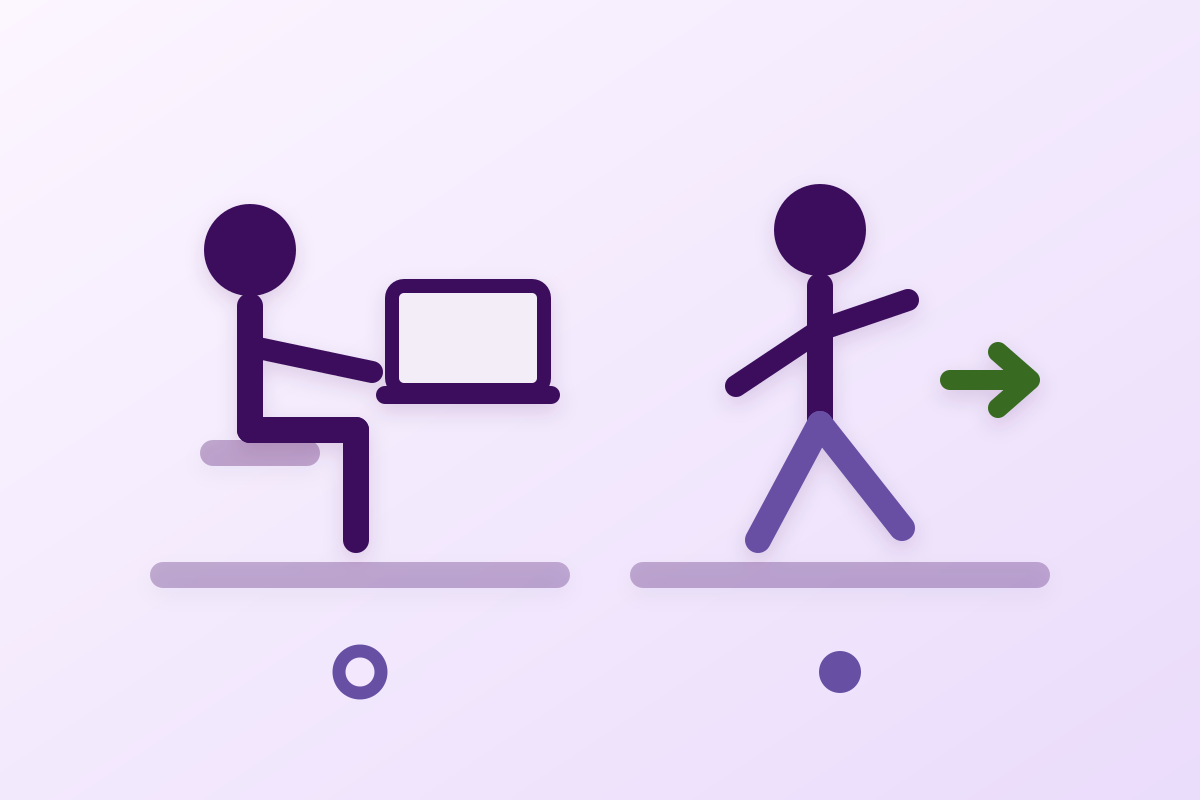
« Postural syndrome » is not a diagnosis: neither workstation adjustment nor sitting posture explains the pain, but exercise does prevent it.
40%of remote workers report moderate to severe discomfort
What follows covers each of these points in detail, with sources. It is there if you need it.
This topic is taught in a course: Neck pain: reason, treat, empower, online with Pierre-Loup Mercier.
1 / 10
9 article chapters · 22 min in total
Not a diagnosis◔ 2 min
« Postural syndrome » denotes a causal attribution, not a diagnosis.
Workstation ergonomics◔ 3 min
Workstation adjustment has no demonstrated effect on upper limb pain.
Sitting posture◔ 2 min
Between occupational sitting and low back pain: strong evidence of no association, no dose-response.
Text neck◔ 2 min
In 582 adults, cross-sectionally, no association between cervical flexion angle and neck pain.
Remote working◔ 3 min
In 843 faculty, staff and managers at an American university, the equipment proved improvised.
What protects◔ 5 min
Exercise prevents a new episode of neck pain, OR 0.49, moderate certainty, with the authors' caveats.
Consultation◔ 2 min
Take the complaint seriously without endorsing the explanation: the pain is real, the presumed cause is not.
Sample programme◔ 1 min
No protocol is specifically validated for the remote worker.
FAQ◔ 2 min
The Cochrane review found no effect of workstation adjustment on upper limb pain.
Train on this
Spine
Pierre-Loup Mercier · Thibault Thérésy
Next comes practice: the course that teaches this topic, with Pierre-Loup Mercier.
Our courses on this topic may be covered by DPC or FIFPL, the French continuing-education funding schemes, depending on your profession and situation.
Occupational health · Spine
Since 2020 the kitchen table has become a workstation, and one explanation has taken hold without going through the evidence: if your back hurts, it is your posture. The available data say otherwise, and they point to other levers, less spectacular but better supported.
“Postural syndrome” is not a diagnosis. What goes by that name is a set of presentations each of which has its own name and its own literature: non-specific neck pain, thoracic spine pain, non-specific low back pain, sometimes upper limb pain. The phrase describes a causal attribution, not a clinical entity, and it is precisely that attribution the data do not support.
Workstation ergonomics does far less than it is credited with. The 2018 Cochrane review retained 15 randomised trials and 2,165 office workers. Workstation adjustment has no effect on upper limb pain or discomfort; nor does the sit-stand desk. The only physical intervention to stand out is the combination of an arm support and an alternative mouse (relative risk 0.52; 95 % CI 0.27 to 0.99; moderate-quality evidence). Training and combined interventions: no demonstrated effect1.
Sitting does not cause low back pain. A systematic review based on the Bradford Hill criteria concluded that there is strong, consistent evidence of no association between occupational sitting and low back pain, with no dose-response2. A review of reviews covering 41 systematic reviews concludes that there is no consensus on causality between spinal posture or physical exposure and low back pain: associations are documented, they do not explain the pain3.
“Text neck” is not a risk factor. Measured objectively with a cervical goniometer in 457 people without neck pain, then reviewed at one year: the cervical flexion angle during smartphone use did not increase the risk of neck pain. Two factors did increase it: poor sleep quality (OR 1.76; 1.17 to 2.63) and insufficient physical activity (OR 2.41; 1.03 to 5.65)5.
What remote working actually changed has been measured. Across 843 university employees sent to work at home, more than 40 % reported moderate to severe discomfort, 85 % were working on a laptop and 55 % on its screen alone, and fewer than 45 % of chairs had adjustable armrests6. In another survey, 51 % reported a worsening of pre-existing discomfort and 24 % entirely new discomfort7.
And what works is known. Exercise reduces the risk of a new episode of neck pain (OR 0.49; 0.31 to 0.76; moderate certainty)8. In preventing low back pain, exercise combined with education reduces the risk of an episode (RR 0.55; 0.41 to 0.74), whereas education alone does nothing (RR 1.03; 0.83 to 1.27), no more than back belts or insoles9. Finally, the benefit of strengthening depends on the volume per session, not on attendance11.
The first job is to take the phrase apart. “Postural syndrome” gathers under one causal label presentations that each have their own diagnosis, prognosis and treatment. This chapter puts them back in their place, and sets out what remote working actually changes about how often they occur.
No international classification recognises a “postural syndrome”. ICD-11 codes what the patient presents with: cervical spine pain (ME84.0), thoracic spine pain (ME84.1), low back pain (ME84.2). The word “postural” adds a presumed cause, and that cause is exactly what the following chapters examine.
This distinction is not pedantry. A patient told they have a “postural syndrome” hears that they hurt because they hold themselves badly, and that the answer is to sit up straight. They draw two false conclusions from it: that their back is fragile, and that the repair lies in a correction rather than in training.
The three presentations a physiotherapist meets in the remote worker are dealt with in their own right elsewhere on this site, and this article does not redo them. Non-specific neck pain covers the examination, the reasoning and the rehabilitation of the cervical spine. Thoracic spine pain covers the thoracic side, including what has to be ruled out before concluding. Non-specific low back pain covers the lumbar spine. This article deals with neither their diagnosis nor their rehabilitation: it deals with the attribution to the workstation, and with what the literature says about it.
This is the chapter that surprises most people, experienced clinicians included. The question has been asked properly, in a Cochrane review restricted to randomised trials, and the answer is mostly negative.
Hoe and colleagues updated in 2018 a review published in 2012, searching eight databases up to 10 October 2018. Strict inclusion criteria: randomised trials of ergonomic interventions for preventing musculoskeletal disorders of the upper limb or neck in office workers, with a baseline prevalence below 25 %. Fifteen trials retained, 2,165 workers. Only one trial was judged at low risk of bias; the other fourteen at high risk, because of small samples and a risk of selection bias1.
Ergonomic interventions: what the Cochrane review retains
15 randomised trials, 2,165 office workers, primary prevention. Each card gives the result and the level of evidence as the authors graded it in GRADE. After Hoe 2018 (PMID 30350850).
The only intervention to stand out combines two devices, in two trials. That is thin ground on which to build a general discourse about the importance of the workstation.
Two faulty readings are waiting. The first is to conclude that ergonomics is useless: that is not what the review says, since it mainly documents an absence of evidence across few and methodologically fragile trials, and explicitly calls for better-quality studies. The second is to ignore the result and carry on attributing to the workstation whatever cannot otherwise be explained.
The tenable position is in between, and it is usable in a session: a comfortable workstation is a legitimate comfort goal, it is not a treatment for pain, and presenting it as one invites a disappointment that costs adherence to everything else.
A useful point about the sit-stand desk, often presented as a solution: the Cochrane review devoted to reducing sitting time at work concludes that the evidence is of very low to low quality for its effect on sitting time itself4, and Hoe's review finds it has no effect on upper limb pain1. The device changes a habit, which is not nothing; it does not treat pain.
The question has been addressed with the right tool: not “is there an association?”, but “does that association satisfy the criteria for causality?”. The answer is clear, and it is not new.
Roffey and colleagues conducted a systematic review devoted to that single question, appraising each Bradford Hill criterion separately. Of 2,766 references screened, 24 studies met the inclusion criteria and five were of high quality (two case-control studies, three prospective cohorts). The result is stated unambiguously by the authors: strong, consistent evidence of no association between occupational sitting and low back pain, moderate evidence for the absence of a dose-response, non-significant risk estimates on the temporality criterion. Conclusion: it is unlikely that occupational sitting is independently causative of low back pain in the populations studied2.
Swain and colleagues took the question up a level: a review of reviews, five databases searched from January 1990 to June 2018, 4,285 publications screened and 41 systematic reviews included, appraised with AMSTAR for quality and against the Bradford Hill criteria for causality. The finding is instructive in its mechanics: positive and null associations coexist across reviews, the meta-analyses lean more readily towards an association, and the reviews restricted to prospective studies are the least able to conclude. The authors' conclusion: despite the abundance of reviews, no consensus exists on causality for physical exposure in low back pain; the association is documented, it provides no causal explanation3.
What we believe, what the literature establishes
Line-by-line comparison of the most widespread claims about the workstation with what the systematic reviews cited in this article allow us to state.
None of these five claims is absurd on the face of it. All have been tested, and none survived the test.
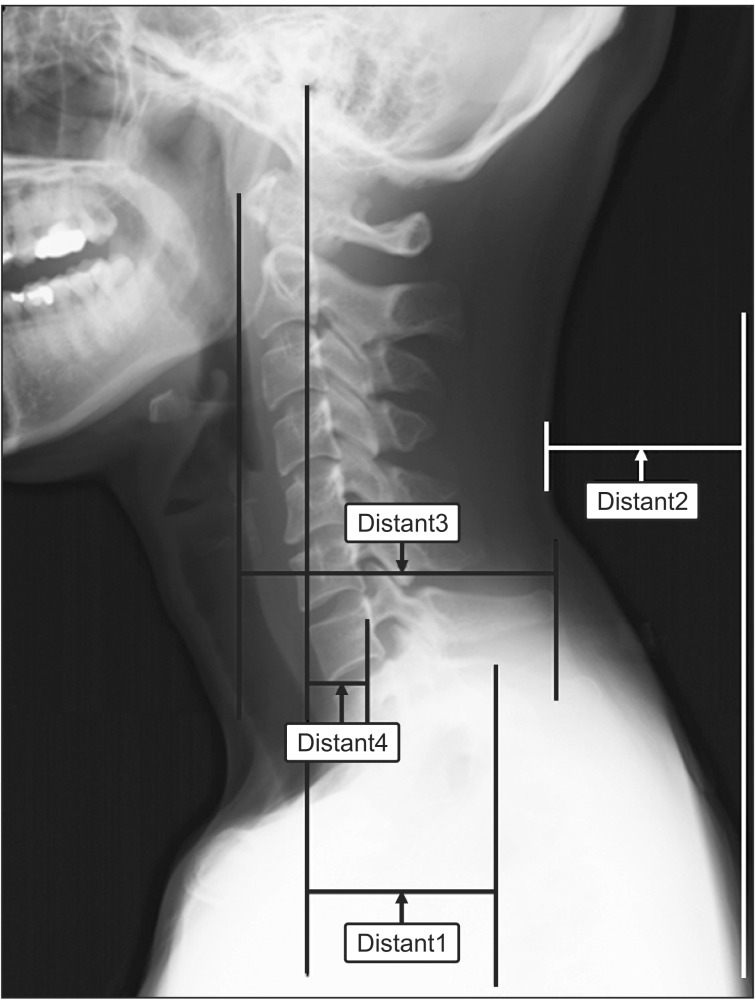
X-rayLateral cervical spine X-ray: four horizontal distances measured between the ear, shoulder and cervical vertebrae, to quantify forward head projection.
Source : Sun et al., Annals of rehabilitation medicine, 2014, figure 1 · CC BY-NC
The idea that cervical flexion in front of a screen produces neck pain has become a cultural given. It has been tested twice by the same team, cross-sectionally and then longitudinally, with an objective measurement of the angle. Both times, the result is negative.
Correia and colleagues studied 582 volunteers aged 18 to 65. The cervical flexion angle was measured with a cervical range of motion device (CROM), standing and then sitting, while the participant typed a message on their smartphone. After multiple logistic and linear regression, no link: neither with the prevalence of neck pain (OR 1.00; 0.98 to 1.02), nor with its frequency, nor with its maximum intensity, whether measured standing or sitting12.
The legitimate objection to a cross-sectional study is the direction of the arrow. The same team therefore followed 457 volunteers without neck pain for twelve months, with the same objective CROM measurement at baseline. At one year, 396 participants were reviewed (87 %) and 40 new cases of neck pain had appeared (10 %).
Result: the cervical flexion angle did not increase the risk of neck pain, neither standing (OR 1.0; 0.97 to 1.04) nor sitting (OR 1.01; 0.98 to 1.04). Two factors did increase that risk: poor sleep quality (OR 1.76; 1.17 to 2.63) and an insufficient level of physical activity (OR 2.41; 1.03 to 5.65)5.
What predicts neck pain at one year, and what predicts nothing
Cohort of 457 adults without neck pain at baseline, 396 reviewed at 12 months, 40 new cases. Adjusted odds ratios and 95 % confidence intervals. After Correia 2025 (PMID 40845624).
The two factors that stand out are the ones a physiotherapist works on, and neither of them is a posture.
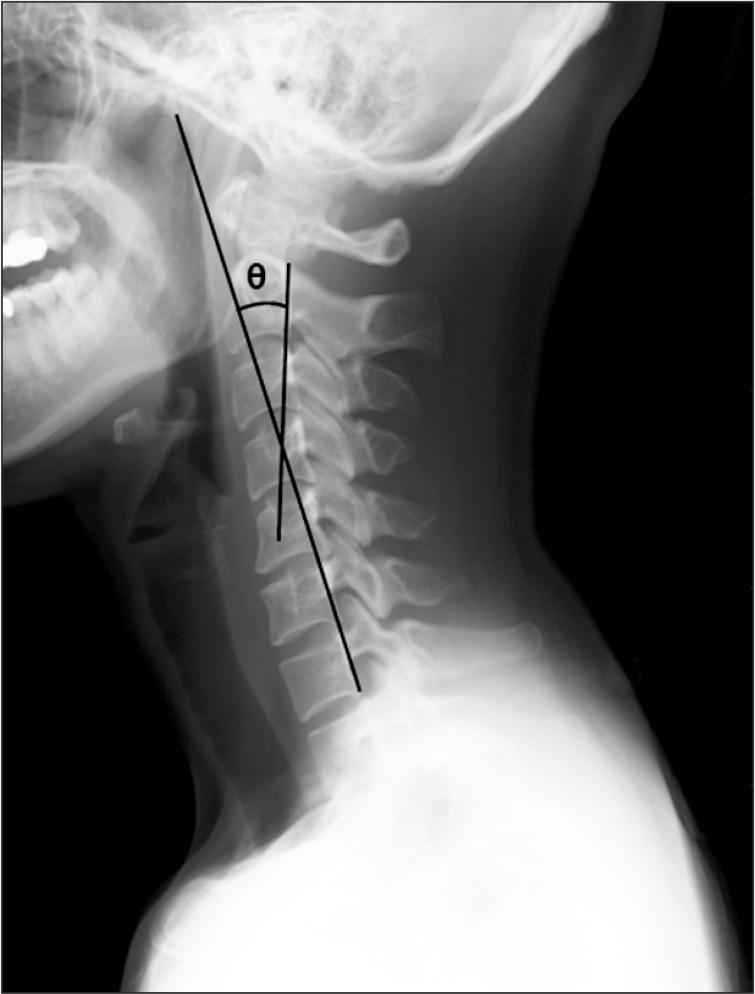
X-rayLateral cervical spine X-ray: measurement of the cervical lordosis angle between C2 and C7 using the posterior tangent method, reduced in forward head posture.
Source : Sun et al., Annals of rehabilitation medicine, 2014, figure 2 · CC BY-NC
The previous chapters dismantle presumed causes. This one describes what actually changed, because the discomfort of remote workers is itself well documented.
The most cited survey covers 843 faculty, staff and managers at an American university sent to work from home. The figures describe an improvised set-up: 85 % always or often used a laptop, and 55 % of all respondents were working on its screen alone, without an external monitor. Fewer than 45 % of chairs had adjustable armrests. And more than 40 % reported moderate to severe discomfort: severe low back and mid-back pain, moderate discomfort of the eyes, neck and head, discomfort of the upper back and shoulders6.
A second survey, of 51 respondents at a Canadian university, measures the change rather than the state: 51 % reported a worsening of discomfort they already had, and 24 % entirely new discomfort since moving home7.
What the move home produced, in figures
Two cross-sectional, self-report surveys conducted during the pandemic among university staff. After Gerding 2021 (PMID 33867366, 843 respondents) and McAllister 2022 (PMID 35358853, 51 respondents).
The discomfort is real and frequent. What these figures do not say is which of the variables changed by remote working is responsible for it.
There is no contradiction, and that is the point to hold. These surveys are cross-sectional and self-reported : they describe an association between a situation and discomfort, without establishing that the workstation is its cause. What remote working changed is not, in any case, limited to the furniture: commuting disappeared, so did social breaks, the day stretched out, the boundary between work and rest blurred, and the postural variety of an office (walking to the printer, changing room, walking to the canteen) was replaced by the stillness of a single room.
In other words, the variable that changed most is probably not posture, but the amount of movement. That is consistent with the prospective risk factor identified for neck pain: insufficient physical activity.
After four chapters of demolition, this one builds. The interventions that work are known and quantified, and they have one thing in common: they increase capacity rather than correct a position.
The most recent meta-analysis on preventing episodes of neck pain screened 4,703 references and retained 5 randomised trials, 1,722 participants, of whom 80 % were office workers. Participants were free of neck pain at baseline, and exercise was compared with no intervention, a placebo, an attention control or a minimal intervention. Result: moderate certainty evidence that exercise reduces the risk of a new episode of neck pain, OR 0.49 (95 % CI 0.31 to 0.76) in the short term, that is up to twelve months. The authors set out two limits: the result was not robust to sensitivity analysis on missing data, and the clinical significance of the effect remains uncertain. Two trials had methodological reservations, three a high risk of bias8.
The benchmark remains the meta-analysis published in JAMA Internal Medicine, which retained 23 publications covering 21 randomised trials and 30,850 participants. The results are unusually instructive, because they set what works against what does not within the same analysis.
Preventing an episode of low back pain: what works and what does not
21 randomised trials, 30,850 participants. Relative risks and 95 % confidence intervals. A relative risk below 1 means fewer episodes. After Steffens 2016 (PMID 26752509).
The same meta-analysis contains the most useful and the most uncomfortable result: education alone prevents nothing. What prevents is exercise, with or without education.
Two practical lessons follow. First, explaining is not enough : a relative risk of 1.03 for education alone is a null result, however good the explanation. Second, education added to exercise does better than exercise alone (0.55 against 0.65), which suggests it works as a vehicle for adherence rather than as a treatment.
In the office worker already in pain, a meta-analysis of 8 randomised trials examined exercise outside the workplace context alone. Seven of the eight trials reported a significant fall in pain intensity on a visual analogue scale and five a fall in the Neck Disability Index after strengthening. The authors conclude that there is low certainty that strengthening the neck, shoulder and scapular muscles reduces pain and disability, while stressing that all eight trials were at high risk of bias10.
This is the most useful study for organising a programme, and it is little known. One hundred and twenty-five female office workers followed a specific strengthening programme for 16 weeks, recording training volume in a logbook (sets × repetitions × load). Regression analysis shows a dose-response relationship: the total training volume was negatively correlated with the change in the pain index (β = −0.16; p = 0.045), and so was the volume per session as well (β = −0.20; p = 0.034).
The result that matters is this: attendance, by contrast, was not correlated with improvement (1.69 sessions a week on average). The authors recommend optimising the volume per session by ensuring a load at 10 to 15 repetition maximum and applying progression11.
What is correlated with the fall in pain, and what is not
125 female office workers, 16 weeks of specific strengthening, volume recorded session by session in a logbook (sets multiplied by repetitions and by load). Regression coefficients on the change in the pain index: the more negative the coefficient, the greater the fall in pain. After Pedersen 2013 (PMID 23254492).
Participants came on average 1.69 times a week, and that frequency explained nothing. It was the content of the session that carried the effect.
| Intervention | Measured effect | Level of evidence | Source |
|---|---|---|---|
| Exercise, preventing neck pain | OR 0.49 (0.31 to 0.76) at 12 months | Moderate certainty, not robust to sensitivity analysis | Teichert 20238 |
| Exercise + education, preventing low back pain | RR 0.55 (0.41 to 0.74) | Moderate quality | Steffens 20169 |
| Exercise alone, preventing low back pain | RR 0.65 (0.50 to 0.86) | Low to very low | Steffens 20169 |
| Neck and scapular strengthening, established neck pain | Fall in pain and disability | Low certainty, 8 trials at high risk of bias | Jones 202410 |
| Arm support + alternative mouse | RR 0.52 (0.27 to 0.99) | Moderate quality, two trials | Hoe 20181 |
| Workstation adjustment, sit-stand desk | No demonstrated effect | One trial each | Hoe 20181 |
| Education alone | RR 1.03 (0.83 to 1.27) | No effect | Steffens 20169 |
| Back belt, insoles | RR 1.01 for both | No effect | Steffens 20169 |
The patient nearly always arrives with a hypothesis already formed, often the right question asked back to front. This chapter offers an approach that takes their complaint seriously without endorsing their explanation.
The opening sentence is nearly always a variant of “I think it's my position”. Two replies are bad ones. Confirming it without reservation installs a belief the data do not support and leaves the patient dependent on a piece of furniture. Contradicting it head-on, in the first session, breaks the alliance before it has begun.
The wording that works acknowledges the observation and shifts the explanation: the pain is real and the context genuinely has changed; what changed is not only the position, it is the amount of movement, the sleep, the hours and the workload. That reopens the field of levers instead of narrowing it to a chair.
No protocol is validated for the “remote worker”. What follows is built from the interventions whose effect has been measured, and each line says where it comes from.
| Aim | Content | Dose | Where it comes from |
|---|---|---|---|
| Capacity of the cervical spine and shoulder girdle | Neck, scapular and shoulder strengthening, with progressive load | A load allowing 10 to 15 repetition maximum, volume tracked session by session | Jones 2024 for the content, Pedersen 2013 for the dose |
| Reducing the risk of a new neck episode | Structured exercise, in whatever format | A programme of at least several weeks, kept up | Teichert 2023, OR 0.49 at 12 months |
| Reducing the risk of a lumbar episode | Exercise, with an educational component alongside it | A sustained programme; education alone is not enough | Steffens 2016, RR 0.55 against 1.03 |
| Restoring the amount of movement | General physical activity, walking, replacing the journeys that disappeared | A weekly target with a figure on it, negotiated with the patient | Correia 2025, insufficient activity OR 2.41 |
| Improving sleep | Regularity, switching off from work, screen hygiene in the evening | A goal followed up like the others | Correia 2025, poor sleep quality OR 1.76 |
| Workstation comfort | External monitor, separate keyboard and mouse, arm support if mouse work is intensive | Once, with no therapeutic promise | Hoe 2018: only the arm support and alternative mouse pairing stands out |
A methodological remark is called for on this table: three of its six rows are built on risk factors identified in cohorts, and not on intervention trials targeting those factors. Does acting on sleep reduce neck pain? Nobody has shown that it does. What we know is that poor sleep precedes the pain in a cohort of 396 people followed for a year. That is reason enough to attend to it, it is not proof of efficacy, and the patient has a right to know the difference.
Yes, for comfort, and no, to treat the pain. The Cochrane review found no effect of workstation adjustment on upper limb pain. A screen at eye level avoids eye strain and discomfort, which is enough to justify it without crediting it with therapeutic power.
It has no demonstrated effect on upper limb pain, and the evidence for its effect on sitting time itself is of very low to low quality. It changes a habit, which has value for postural variety; selling it as a treatment for low back pain is not supported by the data.
That is not what the data say. They say that no particular posture has been shown to cause low back pain or neck pain, and that no postural correction has shown a therapeutic effect. Posture remains a variable of comfort and fatigue, and postural variety is probably more useful than the search for an ideal position.
That happens, and it is not to be disputed. An individual improvement after a change of workstation does not establish causality at group level, and the reverse is also true: a negative meta-analysis does not forbid a given patient from benefiting from an adjustment. What we cannot do is promise that benefit.
It is worth taking the term apart if they use it. Cervical flexion during smartphone use has been measured objectively in 582 and then 457 people, without any association or any prospective risk appearing. The conversation does, however, open naturally onto sleep and physical activity, which do stand out.
The prevention trials measure their results at twelve months, and the dose-response study covers sixteen weeks of strengthening. The order of magnitude to give is therefore that of a quarter, not of a week.
The Cochrane review does find an effect of additional breaks on neck discomfort, of the order of 0.25 points, with very low quality evidence, in data entry operators. It is little, but it is one of the few organisational interventions to stand out, and it costs nothing.
Sixteen references, resolved one by one through the PubMed E-utilities API. For each of them the abstract was read in full and the figures cited in the article checked at source. The year kept is that of the issue, re-read on the XML record: the first “year” field of a PubMed record is sometimes a revision date, and shifts the citation by a year.
The three clinical presentations this article has not covered each have their own page. Non-specific neck pain for the cervical spine, thoracic spine pain for the thoracic side, and non-specific low back pain for the lumbar spine. Two diagnoses not to miss in the screen worker complete the picture: cervicogenic tension-type headache and carpal tunnel syndrome.
Behind this article
An author who explains, a reviewer who checks.
How we write and check our content

Physiotherapist · co-founder of Physio Learning
Marked for life by his first four-hour lecture without a single image, he took a master’s in instructional design so that it would never happen to anyone again. He hunts down publication bias and unreadable slides with the same intransigence.

Head of scientific content
Physiotherapist specialising in neuro-musculoskeletal practice and holder of a master’s in public health. He checks the methodological rigour of every article: primary sources, levels of evidence, no exceptions.
