





Physiotherapy · Primary headaches
A patient comes about their neck. They say they have “had headaches for ever”, that it comes from stress, that their osteopath mentioned C1. This article deals with migraine, a primary headache of neurological origin, where the site's other “head and neck” pages deal with pain arising from the cervical spine or from a cranial nerve: cervicogenic headache, occipital neuralgia, trigeminal neuralgia and cervicogenic dizziness. The distinction is not academic: a migraine treated as neck pain means months of sessions that do nothing to the disease, and a patient left without a preventive treatment when effective ones exist.
Summary written from primary sources verified one by one: every identifier was resolved through the PubMed E-utilities API and every abstract read before being cited. Each figure carries its reference where it is written; the full bibliography, with PMIDs and DOIs, appears at the end of the article. The classification codes are those of the International Classification of Headache Disorders, 3rd edition, taken from the official text.
Migraine in three figures
Very common, very disabling, and massively undiagnosed
Sources: GBD 2021 Headache Collaborators, Cell Reports Medicine 2025 (PMID 40972580); Lucas et al., FRAMIG 3, Headache 2006 (PMID 16643573); Henry et al., Neurology 2002 (PMID 12136063).
Clinical summary
- Migraine is a neurological disease, not a cervical symptom. It is diagnosed on positive clinical criteria (ICHD-3 1.1 and 1.2), without imaging or laboratory tests, and examination of the cervical spine plays no part in it.
- You see them, and they are not labelled. In the FRAMIG 3 national survey, 21.3 % of French adults met the criteria for migraine and 60 % of them did not know their diagnosis (PMID 16643573). The question to ask is therefore not “do you get migraines” but “describe an attack to me”.
- The neck pain of an attack is not neck pain in the usual sense. It belongs to the migraine picture: across 50 patients, 32 reported neck symptoms, 10 of them before the headache itself (PMID 8163372). Treating the neck of a patient whose neck is a symptom is treating the smoke.
- Some migraine sufferers do nevertheless have a genuine upper cervical dysfunction. On palpation of the upper cervical spine, 47 % reproduce pain referred to the head and 42 % local pain alone; 11 % feel nothing (PMID 28952052). It is that subgroup, and it alone, for which cervical work is appropriate.
- The strongest evidence in rehabilitation is aerobic exercise, with a real but modest effect: 0.6 fewer migraine days a month, on moderate-quality evidence (PMID 30764753). Manual therapy did no better than usual care on the number of migraine days in the most recent randomised trial (PMID 41705211).
- The physiotherapist's main duty is triage. The SNNOOP10 list of red flags had a sensitivity of 100 % for spotting high-risk headaches in an emergency cohort (PMID 36003002). Thunderclap headache, a headache that changes character, a focal deficit, pregnancy or the post-partum period: none of these is rehabilitated.
What is a migraine, and what is not one?
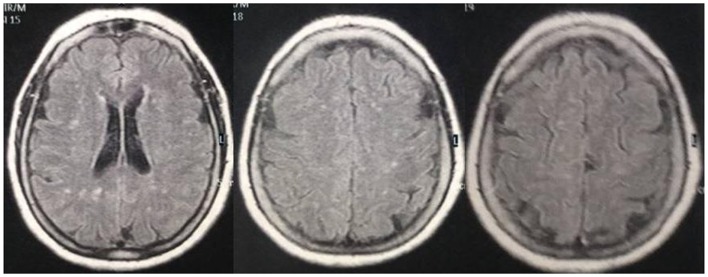
MRIAxial brain MRI in a patient with a long history of migraine, showing white matter abnormalities frequently found in people with migraine.
Source : Valença, Frontiers in Neurology, 2014, figure 1 · CC BY
The diagnosis of migraine is clinical, positive, and rests on counting. Knowing it by heart changes a consultation: you stop asking the patient what they think they have, and you get them to describe what they experience.
Migraine belongs to the first part of the International Classification of Headache Disorders, that of primary headaches: diseases in themselves, and not symptoms of something else. Its heading carries the ICHD-3 code 1. Migraine, with two main forms, 1.1 Migraine without aura and 1.2 Migraine with aura, and an advanced form, 1.3 Chronic migraine (PMID 29368949).
The criteria for migraine without aura run to five lines, and it is their simplicity that makes them usable in the treatment chair.
| Criterion | 1.1 Migraine without aura | What that gives you at the interview |
|---|---|---|
| A. Number | At least five attacks fulfilling criteria B to D | One or two attacks are not enough: below five, the classification requires “probable migraine” (1.5.1) |
| B. Duration | Attacks lasting 4 to 72 hours, untreated or unsuccessfully treated | A twenty-minute headache is not a migraine. In children and adolescents, the lower limit drops to 2 hours |
| C. Characteristics | At least two of: unilateral location, pulsating quality, moderate or severe intensity, aggravation by routine physical activity (or avoidance of it) | The fourth item is the most discriminating in practice: “does climbing stairs make the pain worse?” |
| D. Accompanying features | At least one of: nausea or vomiting; photophobia and phonophobia | Photophobia and phonophobia are required together, not either/or |
| E. Exclusion | Not better accounted for by another ICHD-3 diagnosis | This is where the sorting of red flags is played out |
| Aura (1.2) | Fully reversible focal neurological symptoms, most often visual, developing gradually and lasting 5 to 60 minutes | The aura develops gradually: a sudden, complete onset suggests a stroke, not an aura |
Criteria taken word for word from the official text of the International Classification of Headache Disorders, 3rd edition (ichd-3.org); publication reference: Cephalalgia 2018 (PMID 29368949).
Three remarks from the official text are worth knowing, because they close as many false trails. Migraine in children is more often bilateral than in adults, one-sidedness appearing only in late adolescence. An occipital headache in a child is rare and calls for diagnostic caution. Finally, a migraine attack can be accompanied by cranial autonomic features, lacrimation or nasal congestion included: their presence therefore does not by itself point to cluster headache.
The diagnosis of migraine does not rest on what the patient thinks they have. It rests on the duration of an attack, two characteristics of the pain, one accompanying feature, and five episodes.
What migraine is not
The site's corpus already covers four neighbours of migraine, and each is distinguished by a single sign. This table is made to be read from right to left: you start from the sign and work back to the diagnosis.
| Presentation | Rhythm and duration | The sign that settles it | The page on the site |
|---|---|---|---|
| Migraine ICHD-3 1 | Attacks of 4 to 72 h, a few a month, normal between attacks | Aggravation by routine physical activity, with photophobia and phonophobia; the patient withdraws and keeps still | This page |
| Cervicogenic headache ICHD-3 11.2.1 | Continuous or fluctuating, over hours or days | The pain is reproduced by cervical movement, and the side never changes | Cervicogenic tension-type headache |
| Occipital neuralgia ICHD-3 13.4 | Paroxysms of a few seconds to a few minutes | Tenderness on palpation of the occipital nerve, dysaesthesia of the scalp, relief from an anaesthetic block | Occipital neuralgia |
| Trigeminal neuralgia ICHD-3 13.1.1 | Shocks lasting a fraction of a second to 2 minutes, with a refractory period after the attack | The cutaneous or mucosal trigger zone, reproducible, and the complete absence of pain between attacks | Trigeminal neuralgia |
| Cluster headache ICHD-3 3.1 | Attacks of 15 to 180 minutes, one every other day to eight a day, often at night | The ipsilateral autonomic features and the restlessness: the patient cannot keep still, where the migraine sufferer seeks darkness and silence | Cluster headache |
| Dizziness and migraine | Vestibular episodes lasting minutes to hours, with or without headache | Vestibular migraine is the first cause to rule out when neck pain and dizziness go together: it accounts for 21 % of chronic dizziness in specialist clinics | Cervicogenic dizziness |
Codes and criteria: ICHD-3, Cephalalgia 2018 (PMID 29368949). The distribution of causes of chronic dizziness is set out, with its sources, in the site's article on cervicogenic dizziness.
Where this page stops. Vestibular migraine is dealt with in depth in the article on cervicogenic dizziness, where it occupies its rightful place: that of the diagnosis to rule out first before concluding on a cervical origin. We do not duplicate it here.
Key point
- Five attacks, 4 to 72 hours, two characteristics out of four, one accompanying feature: the diagnosis comes down to one sentence.
- Aggravation by routine exertion is the most useful item in practice, and it immediately separates migraine from tension-type headache.
- Autonomic features can accompany a migraine: they do not make it a cluster headache.
- An occipital headache in a child is not unremarkable, and is not a migraine by default.
Who is affected, and how many migraine sufferers do not know it?
The figure that matters to a physiotherapist is not the prevalence. It is the proportion of migraine sufferers who do not know they are, because that measures exactly the place you can take.
In the Global Burden of Disease study, migraine affected 1.2 billion people in 2021, against 2.0 billion for tension-type headache. Tension-type headache is more common; migraine is markedly more disabling, and the burden is concentrated disproportionately in women aged 30 to 44 (PMID 40972580). Migraine remains the second leading cause of years lived with disability worldwide (PMID 33974014).
In France, the benchmark measurement is old but solid, because it rests on a representative sample of the general population. Across 10,585 people screened, the standardised prevalence of migraine in the strict sense (categories 1.1 and 1.2) was 7.9 %, with a considerable difference by sex: 11.2 % in women against 4.0 % in men. Including incomplete migraine pictures, the total prevalence reached 17.0 % (PMID 12136063). Two years later, with the revised criteria that include probable migraine, the FRAMIG 3 survey identified 1,179 migraine sufferers out of 10,532 people surveyed, that is 21.3 % (PMID 16643573). The whole French series, eleven studies over more than thirty years, has been the subject of a recent review (PMID 39627053).
Four French figures the clinic needs to know
A disease of young women, largely unrecognised, and little treated preventively
Sources: Henry et al., Neurology 2002 (PMID 12136063); Lucas et al., Headache 2006 (PMID 16643573); Lantéri-Minet et al., Pain 2003 (PMID 12620605).
The last figure is the one that explains the most consultations. Chronic daily headache affected 2.98 % of the French general population, and two thirds of those people had a migraine-like picture. Their impact and their use of healthcare clearly exceeded those of the episodic migraine sufferers in the same sample: 28.2 % reached grades 3 or 4 on the MIDAS scale against 12 %, and above all, only 6.6 % were receiving a preventive treatment while 88 % were taking non-specific analgesics (PMID 12620605). That is the very definition of the situation that produces medication-overuse headache.
Key point
- One woman in nine and one man in twenty-five have migraine in France, in the strict sense.
- Six migraine sufferers in ten do not know it, and eight in ten are not under follow-up: the patient who talks about “tension headaches” is often an undiagnosed migraine sufferer.
- Three per cent of the population has chronic daily headache, and barely 7 % of them have a preventive treatment.
When does a headache stop being a migraine?
This is the most important chapter in this article, and the only one whose omission can cost a life. A primary headache is only diagnosed once secondary headaches have been ruled out, and that step cannot be delegated.
The proportion of secondary headaches depends entirely on where you work. In an international cohort of 5,293 patients attending emergency departments for headache, 6.1 % had a serious cause identified (95 % confidence interval: 5.5 to 6.8). The independent predictors were a new neurological deficit, then a history of cancer, an age over 50 and a recent head injury (PMID 38658053). In private practice the proportion is far lower, but the consequence of missing one is the same.
The SNNOOP10 list
The reference tool is the SNNOOP10 list, published in Neurology in 2019, which sets out fifteen warning signals for secondary headaches (PMID 30587518). Its performance has been measured: in a prospective series of 100 patients triaged in the emergency department, of whom 46 had a high-risk headache, the sensitivity of the complete list was 100 % (95 % confidence interval: 90.2 to 100). The most sensitive items taken individually were neurological deficit or dysfunction (75.5 %), a change in pattern or the recent onset of a new headache (64.4 %) and onset after the age of 50 (64.4 %). The most specific were post-traumatic onset (94.5 %), a history of cancer (89.1 %) and systemic signs (89 %) (PMID 36003002).
| Signal | What is feared | What to do in the clinic |
|---|---|---|
| Systemic signs, including fever | Meningitis, infection, arteritis | Medical referral the same day |
| History of cancer | Metastasis, primary tumour | Referral, with no resumption of cervical treatment |
| Neurological deficit, including consciousness | Intracranial lesion, stroke | Emergency. Call the emergency services if the deficit is of recent onset |
| Sudden or abrupt onset | Subarachnoid haemorrhage, dissection, venous thrombosis, reversible vasoconstriction | Emergency. This is thunderclap headache |
| Onset after the age of 65 | Giant cell arteritis, tumour | Prompt medical referral |
| Change in pattern or a new headache | Any secondary cause | Referral. The most sensitive item after deficit |
| Positional headache | Intracranial hypotension or hypertension | Medical referral |
| Precipitated by sneezing, coughing or exertion | Craniocervical junction malformation, posterior fossa lesion | Medical referral |
| Papilloedema | Intracranial hypertension | Referral, fundoscopy |
| Progressive headache and atypical presentation | Space-occupying lesion | Medical referral |
| Pregnancy or post-partum | Cerebral venous thrombosis, pre-eclampsia, reversible vasoconstriction | Referral, see the next chapter |
| Painful eye with autonomic features | Posterior fossa lesion, pituitary involvement, glaucoma | Ophthalmological and neurological referral |
| Post-traumatic onset | Haematoma, dissection | Referral. The most specific item |
| Immunosuppression, including HIV | Opportunistic infection, lymphoma | Medical referral |
| Analgesic overuse or a new medication | Medication-overuse headache | Ask about the number of days of use per month |
List and wording: Do TP et al., Neurology 2019 (PMID 30587518). Sensitivities measured: García-Azorín D'et al., Cephalalgia 2022 (PMID 36003002). What to do in the clinic is a transposition by the editorial team, not a recommendation from the authors.
Triaging a headache in the clinic
Three questions before anything else, and the fourth only if the first three are negative
A clinic transposition of the SNNOOP10 list: the three questions take up the items with the highest measured sensitivity. They do not replace the complete list, reproduced in the table above.
- Thunderclap headache: maximum intensity reached in under a minute. Subarachnoid haemorrhage until proven otherwise, but also cerebral venous thrombosis and reversible cerebral vasoconstriction syndrome. Call the emergency services.
- A headache that changes character in a known migraine sufferer: a new location, a new rhythm, a new intensity, or a loss of response to the usual treatments. The patient often says it themselves: “this is not my migraine”.
- A focal neurological deficit that does not resolve like an aura, or that comes on abruptly instead of developing over several minutes.
- Pregnancy or post-partum, and by extension combined oral contraception: a context for cerebral venous thrombosis, developed in the next chapter.
- A febrile headache with neck stiffness: do not confuse meningeal stiffness with a mechanical cervical restriction.
- A headache after recent neck trauma, with unilateral neck or facial pain: arterial dissection. No manipulation.
Key point
- Triage comes before diagnosis, which comes before treatment. Reversing that order is the only truly serious error in this field.
- The two most sensitive items are neurological deficit and a change in the pattern of the headache: two questions, asked at every session in a patient with headaches.
- A known migraine sufferer is not protected: they can have a secondary headache, and their label hides it.
Why should cerebral venous thrombosis concern you?
This disease does not belong to physiotherapy, and nothing that follows is treated in a clinic. It appears here for one reason only: its most frequent presentation is an isolated headache in a young woman, which is exactly the patient who walks through a clinic door talking about their migraines.
Cerebral venous thrombosis is occlusion of a dural venous sinus or of a cerebral vein. Its incidence is estimated at 1.32 per 100,000 a year in high-income countries, and it preferentially affects children, young adults and women, particularly during pregnancy and the post-partum period (PMID 27816347). In the benchmark international study, ISCVT, which followed 624 patients in 89 centres and 21 countries, 465 of the 624 patients, that is 75 %, were women, younger than the men and more often presenting with headache as the main feature (PMID 19478226).
The trap: headache can be the only sign
This is the point that justifies this chapter. In the multicentre VENOST study, of 1,144 patients with cerebral venous thrombosis, 287 presented with an isolated headache, against 857 with other associated signs. Onset there was more often subacute or chronic than in the group with associated signs, where acute onset dominated. A decisive point for a practitioner who will see the patient again: 29 % of the isolated headache group developed other neurological signs during follow-up (PMID 34254656).
A French series had established it earlier, and even more disturbingly. Of 123 consecutive patients, 17 had headache as their only manifestation, with a normal brain CT and cerebrospinal fluid examination. The lateral sinus was involved in 15 of them. Onset was gradual in 11, acute in 3 and thunderclap in 3. Once established, the headache was continuous in 15 and unilateral in 13, on the side of the occluded sinus. The authors conclude that magnetic resonance imaging and venography must be requested for any recent, progressive or thunderclap headache, even when the CT and the lumbar puncture are normal (PMID 16024884).
The profile of cerebral venous thrombosis
A disease of young women, a quarter of whose cases present with headache alone
Sources: Coutinho JM et al., Stroke 2009, ISCVT data (PMID 19478226); Duman T et al., VENOST study, Agri 2021 (PMID 34254656); Ferro JM et al., ISCVT, Stroke 2004 (PMID 14976332).
The outlook is good once the diagnosis is made: in ISCVT, after a median 16 months of follow-up, 57.1 % of patients had no symptoms and 22 % had minor ones. But 8.3 % had died, and a subgroup of about 13 % remained at high risk of a poor outcome, identifiable on admission: coma, impaired alertness, haemorrhage on the initial CT, deep venous system thrombosis, central nervous system infection, cancer (PMID 14976332). Treatment is anticoagulation, started in hospital, and its conduct is the subject of a GRADE-based European guideline (PMID 28833980).
A young woman, on combined oral contraception or in the weeks following childbirth, describing a new and continuous headache: it is not a migraine until a doctor has said so.
Why this disease occupies a chapter of a physiotherapy article. The site used to receive visitors on a page devoted to cerebral venous thrombosis, now gone. We have not reopened that page: the diagnosis rests on venography and the treatment on hospital anticoagulation, two areas where a physiotherapy page would add nothing and might suggest community management. The subject is therefore covered where it genuinely serves, that is among the red flags of headache, and the old address now leads here.
- new and continuous headache, developing gradually over days, in a woman under 50.
- Context: pregnancy, post-partum, combined oral contraception, known thrombophilia, cancer, dehydration, neighbouring ENT infection.
- the thunderclap type: three of the seventeen isolated headache cases in Cumurciuc series began that way.
- The later appearance of vomiting, visual disturbance, a seizure or a deficit: that is the course seen in 29 % of the isolated headaches in VENOST.
- A normal brain CT is not enough to rule the diagnosis out, and nor is a normal lumbar puncture.
Key point
- Cerebral venous thrombosis presents with an isolated headache in a quarter of cases, in a population of young women.
- No element of the physiotherapy examination can rule it out, and no physiotherapy treatment has a place until it has been ruled out.
- The right course is referral, with the reason written down: “recent, continuous headache, hormonal context, venous imaging to be considered”.
Does the neck make the migraine, or does the migraine hurt the neck?
This is the question that decides everything else, and the literature answers it with a nuance: both, but not in the same patient. Knowing which side the person in front of you is on is the physiotherapist's own competence in this field.
That migraine comes with neck pain has long been established. In an old but much-cited series, across 50 migraine sufferers questioned phase by phase, 32 reported neck pain or stiffness: 10 during the premonitory phase, 30 during the headache itself and 10 during the recovery phase (PMID 8163372). Neck stiffness is in fact one of the canonical premonitory symptoms of an attack, alongside yawning, thirst and frequent urination (PMID 30074545), and that premonitory phase has been documented by electronic diary in a multicentre study (PMID 12654956).
The four phases of an attack, and where the neck appears
Neck pain often precedes the headache: it is a symptom of the attack, not necessarily its cause
The numbers per phase overlap: the same patient can report cervical symptoms in several phases, which is why the total exceeds 32.
A subgroup does have an upper cervical dysfunction
Kerstin Luedtke's team measured what palpation of the upper cervical spine gives in 179 migraine sufferers and 73 matched controls, examined by a physiotherapist blinded to the diagnosis. The technique combined oscillatory movements and sustained pressure. It separates migraine sufferers into three groups: 11 % with no pain, 42 % with local pain alone, and 47 % in whom sustained pressure reproduces pain referred to the head (PMID 28952052). The same authors have since summarised their whole research programme: musculoskeletal dysfunctions are frequent in migraine sufferers, and it is the reproduction of pain referred to the head, and not simple local tenderness, that appears to identify the relevant subgroup (PMID 37331926). An earlier study had found, in 55 women with episodic migraine and 16 with chronic migraine compared with 22 controls, alterations in upper cervical mobility and in cervicocephalic kinaesthesia (PMID 28118694).
Stratification by palpation of the upper cervical spine
Of 179 migraine sufferers examined blind, fewer than one in two reproduces pain referred to the head
Examination carried out by a physiotherapist blinded to the diagnosis, compared with 73 controls matched for age and sex.
But the neck pain of a migraine sufferer is not neck pain in the usual sense
This is the indispensable counterweight, and it comes from an Australian team. Comparing 124 migraine sufferers (106 episodic, 18 chronic) with 32 healthy controls and 21 patients with idiopathic neck pain, using a complete battery (cervical range and movement accuracy, segmental dysfunction, neuromuscular and sensorimotor measures), the authors conclude that neck pain associated with migraine does not necessarily reflect cervical musculoskeletal dysfunction. Patients with a comorbid cervical disorder had been excluded, precisely to isolate the question (PMID 34214181).
The practical consequence is direct. Faced with a migraine sufferer whose neck hurts, the question is not “should the neck be treated?” but “does this neck show, between attacks, the picture of a cervical disorder?”. Range, endurance of the deep flexors, segmental dysfunction reproducing the usual pain, examined away from an attack: if none of that is found, the neck is a symptom, and it will be treated by treating the migraine.
Neck pain is present in nearly two thirds of migraine sufferers. Cervical dysfunction is not. Confusing the two is the error that has necks rehabilitated for months without changing the number of attacks.
Key point
- Cervical symptoms belong to the migraine picture, and can precede the headache by several hours.
- Palpation of the upper cervical spine separates migraine sufferers into three groups: 11 % with no pain, 42 % local pain, 47 % pain referred to the head.
- Neck pain in a migraine sufferer does not prove a cervical dysfunction: it has to be looked for in its own right, away from attacks.
- The cervical assessment is done between attacks. During an attack everything is tender, and nothing is interpretable.
What can physiotherapy actually do, and at what level of evidence?
This chapter announces no spectacular good news, and that is precisely its value. An effective but modest modality, correctly presented to a patient, produces a better alliance than a promise the facts will disprove within three months.
Aerobic exercise, the best-supported modality
Two meta-analyses converge, and the gap between them is instructive. The first retained six trials: it concludes that there is moderate-quality evidence that aerobic exercise reduces the number of migraine days, with a mean reduction of 0.6 days a month (standard deviation 0.3). The authors could not conclude on pain intensity or attack duration, for want of homogeneous measures (PMID 30764753). The second, across 10 articles and 508 patients, finds significant short-term effects on intensity (standardised mean difference 1.25; 95 % confidence interval: 0.47 to 2.04), frequency (0.76; 0.32 to 1.2) and duration (0.41; 0.03 to 0.8), on low to moderate quality evidence. The authors themselves report a significant publication bias on the quality of life outcome (PMID 31904889). Recent network meta-analyses have looked for the optimal dose and put protocols combining aerobic work and strengthening at the top (PMID 41142313).
Manual therapy, a recent result that calls for nuance
The most relevant trial for our practice was conducted in primary care, on exactly the population that consults us: migraine sufferers who also have neck pain. Thirty-six patients received manual therapy (mobilisations, exercises, myofascial techniques) and thirty-one usual general practice care, with follow-up at 12, 26 and 52 weeks. On the primary outcome, the number of migraine days, there is no significant difference, nor on most secondary outcomes. The manual therapy group did, however, have higher pressure pain thresholds over the occipital muscles and better perceived recovery at 12 and 52 weeks, and used less preventive medication. The authors conclude that manual therapy is not superior to usual care on migraine days, but that patient preference and satisfaction may come into it (PMID 41705211).
Earlier, smaller trials had reported favourable effects of articulatory protocols (50 subjects randomised, PMID 33989990) and a three-armed trial compared a multimodal approach (manual therapies, cervical exercises and pain neuroscience education) with its individual components in 75 participants (PMID 40460766). The overall picture remains one of an uncertain effect on the disease and a plausible one on the cervical impact.
Behavioural approaches, to know about and to refer for
The most recent systematic review covers 50 trials and 6,024 adults. It concludes that cognitive behavioural therapy, relaxation training and mindfulness-based therapies may reduce attack frequency, on evidence described as low, and that education alone targeting behaviour may improve impact. For biofeedback, acceptance and commitment therapy and hypnotherapy, the data were insufficient to conclude. Most trials were at high risk of bias (PMID 39968795).
Rehabilitation modalities and level of evidence
Cards stacked from best supported to least supported, with the measured effect and its source
The level-of-evidence labels are those stated by the authors of the reviews cited. The last card is a conclusion drawn by the editorial team from an absence of data, not from a negative review.
Key point
- Aerobic exercise is the only rehabilitation modality carried by moderate-quality evidence, and its effect is real but modest.
- Manual therapy did not beat usual care on the number of migraine days, in patients selected precisely for their associated neck pain.
- Announcing a modest effect and obtaining it is better than promising that the attacks will stop.
- The physiotherapist's most useful place remains upstream: recognising, triaging, and referring the six migraine sufferers in ten who do not know it.
What can medical treatment do, and why does that concern you?
A physiotherapist does not prescribe. But they see their patient twenty times where the doctor sees them twice, and they are therefore best placed to spot the two situations that spoil a treatment: the absence of a preventive treatment, and analgesic overuse.
Migraine prevention has changed its face. The American Headache Society published an update to its consensus statement on integrating new treatments in 2021 (PMID 34160823), then in 2024 a position statement affirming that treatments targeting calcitonin gene-related peptide (CGRP) are a first-line option for prevention, where they had previously been reserved for failures of non-specific treatments (PMID 38466028). The International Headache Society for its part has called for the goals of preventive treatment to be raised, aiming at freedom from attacks rather than the halving that has become the standard in trials (PMID 39980456), and for earlier treatment to prevent disease progression (PMID 41134822).
Medication-overuse headache
This is the point where your observation is worth its weight in gold. Medication-overuse headache affects between 1 and 2 % of the world's population, and is defined as a headache occurring on more than fifteen days a month in a patient with a pre-existing primary headache, arising from the regular use of acute treatments (PMID 38568489). Recall the French figure: among people with chronic daily headache, 88 % were taking non-specific analgesics and only 6.6 % had a preventive treatment (PMID 12620605). The question to ask is simple and takes one sentence: “how many days a month do you take something for your head?”. Beyond ten days for specific treatments or fifteen for simple analgesics, there is something to raise with the family doctor.
The transformation of episodic migraine into chronic migraine has been the subject of a systematic review of its risk factors, which identifies in particular initial attack frequency, medication overuse, obesity, sleep disorders and painful and psychiatric comorbidities (PMID 30589090). Several of those factors are exactly the ones a physiotherapist already works on.
Key point
- Anti-CGRP antibodies are now positioned as first line for prevention by the American Headache Society.
- One question per assessment is enough to screen for medication overuse: the number of days of use per month.
- Several factors in chronification (sleep, weight, painful comorbidities), fall within the field where a physiotherapist already acts.
Migraine in women: what do hormones change?
Migraine is three times more common in women, and its relationship with hormones has a direct consequence for vascular risk. It is the only chapter of this article where the information you pass on can change a prescription.
Migraine with aura is associated with an increased risk of ischaemic stroke, and that association is amplified by combined oral contraception and by smoking (PMID 23432442). The subject has been debated since pills came to contain oestrogen doses far below those of the 1960s and 1970s on which the original contraindication rested (PMID 28806162), and a case-control study has specifically examined the effect of oestrogen dose and migraine subtype (PMID 36752588). Recent work on British general practice data has compared stroke risk between combined oral contraceptives and progestogen-only pills in women with migraine with aura (PMID 42096712). The French synthesis on migraine and contraception sets out the prescribing markers (PMID 25727163).
What that implies in the clinic comes down to one sentence: if a patient describes visual auras and also tells you she takes a combined oral contraceptive, the only thing to do, and it matters, is to ask her whether her doctor knows about those auras. Many have never mentioned them, because they do not connect them with their contraception.
Pregnancy and the post-partum period deserve separate vigilance, and for a reason that is not migraine itself. They are prothrombotic states, and cerebral venous thrombosis is over-represented in them: it is item 11 of the SNNOOP10 list (PMID 30587518). A new headache in a pregnant woman or one who has recently given birth is never unremarkable. The question of the safety of later pregnancies after cerebral venous thrombosis has in fact been the subject of a dedicated follow-up of the ISCVT cohort (PMID 28974635).
- Visual aura in a woman on combined oral contraception: information to pass back to the prescriber.
- A new headache during pregnancy or in the weeks after childbirth: medical referral, without exception.
- An aura that changes shape, lasts beyond an hour, or leaves a deficit: urgent referral.
What do published cases teach us?
The cases that follow are all genuinely published and referenced reports. None is reconstructed, and none is a flattering example: they were chosen because they illustrate errors our profession makes.
A cervical manipulation on a headache that had changed
The most instructive case for a French physiotherapist was published in the Annales de réadaptation et de médecine physique. A 39-year-old woman, a current smoker, with migraine for ten years, presents with an unusual headache associated with neck pain. She is treated with cervical spine manipulation. Seven hours later, she develops a crossed syndrome with a right sensorimotor deficit and a cerebellar syndrome, a picture of vertebrobasilar ischaemia. The authors, themselves physical medicine physicians, recall that the incidence of these accidents is underestimated and that the risk falls if the contraindications are observed (PMID 18586346).
Two features of this case appear word for word in the list of red flags: the unusual headache in a known migraine sufferer, and the associated neck pain with a new headache, which must raise the possibility of arterial dissection before any technique. The association between cervical manipulation and cervical artery dissection has been the subject of dedicated work, including an analysis of American health databases comparing several study designs (PMID 37422607) and a review of 64 medico-legal files that could not identify either the at-risk patient or the type of manipulation involved (PMID 12195461). Two recent reports of carotid dissection after manipulation have been published (PMID 34971321).
A cerebral venous thrombosis in a woman on contraception
A 22-year-old woman, on oral contraception, presents with a right-sided headache, blurred vision and dizziness of four days' duration. Magnetic resonance venography shows complete thrombosis of the right transverse sinus, the sigmoid sinus and the internal jugular vein, together with partial thrombosis of the superior sagittal sinus and the left transverse sinus (PMID 33942790). Another report describes a cerebral venous thrombosis in a 31-year-old woman after a brief exposure to oral contraception, prescribed for endometriosis (PMID 35786211). The initial reason for consulting, in both cases, could have been referred to a physiotherapy clinic had it been labelled “headache and dizziness of cervical origin”.
What these cases do not prove
A case report does not demonstrate a frequency. These reports establish neither that cervical manipulations are dangerous in general, nor that headaches in women on contraception are thromboses. They establish something more limited and more useful: these sequences exist, and they all begin with a signal that was on the list of red flags.
How do you apply this in the clinic?
This chapter sums up what to do in five acts, three of which are not technical at all.
1. Ask three questions of every patient with a headache
They take less than a minute, and cover the most sensitive items of the SNNOOP10 list: was the onset sudden? Is this headache new, or different from usual? Is there a neurological deficit, a fever, a pregnancy or a post-partum period? A single positive answer is enough to suspend the treatment plan and refer.
2. Have them describe an attack, never ask for a diagnosis
Duration, side, pulsating quality, effect of exertion, nausea, photophobia and phonophobia: six elements, which are enough to recognise the picture. Six migraine sufferers in ten do not know they are (PMID 16643573); asking them whether they get migraines therefore means asking the question they do not have the answer to.
3. Examine the neck between attacks, and look for referred pain
Overall range, upper cervical mobility, endurance of the deep flexors, and above all sustained palpation of the upper cervical spine looking for pain referred to the head, the sign that identifies the relevant subgroup (PMID 28952052). In the absence of a cervical picture in its own right, do not build a cervical treatment.
4. Build the programme around aerobic exercise
It is the best-supported modality, and it is announced for what it is: a mean reduction of the order of half a migraine day a month, obtained through regular, progressive practice, and not through passive sessions (PMID 30764753). Adding strengthening work is consistent with the most recent network meta-analyses (PMID 41142313).
5. Count the days of acute treatment
One question per assessment, recorded in the notes. Beyond ten or fifteen days a month depending on the drug class, the information goes back to the family doctor. It is the most cost-effective act on the list, because it targets the only mechanism of worsening that is entirely reversible.
Key point
- Three triage questions, six elements describing an attack, one cervical examination between attacks: the useful consultation fits into ten minutes.
- The programme is built on aerobic exercise, with a goal announced without exaggeration.
- Counting the days of acute treatment is the most cost-effective act of all.
Frequently asked questions
Can a migraine really come from the neck?
No, in the sense that the cervical spine is not the cause of a migraine, which is a primary neurological disease. But yes, in the sense that some migraine sufferers also have an upper cervical dysfunction: 47 % of the 179 migraine sufferers examined by Luedtke and May reproduced pain referred to the head on sustained palpation of the upper cervical spine (PMID 28952052). A headache genuinely caused by the neck has another name, cervicogenic headache, and other criteria: that is the subject ofa separate article on this site.
Can the cervical spine of a migraine sufferer be manipulated?
The question only arises after triage, never before. A new, unusual headache, or one associated with recent neck pain, must raise the possibility of arterial dissection and rules out any technique, as illustrated by the report of a 39-year-old migraine sufferer who had vertebrobasilar ischaemia seven hours after a manipulation (PMID 18586346). In a stable migraine sufferer with no red flag, the most recent randomised trial showed no superiority of manual therapy over usual care as regards the number of migraine days (PMID 41705211).
How many sessions does it take to make migraines disappear?
None. Physiotherapy does not make a migraine disappear, and no data allow that to be promised. What it can aim at, and document, is a modest reduction in the number of attack days through aerobic exercise, an improvement in the cervical impact, and referral towards a preventive treatment when one is missing. Freedom from attacks is a goal the International Headache Society assigns to medical preventive treatment, not to rehabilitation (PMID 39980456).
My patient has had migraines for twenty years and their CT is normal. Is that reassuring?
For migraine, yes: its diagnosis is clinical and requires no imaging. For a new or altered headache, no. In Cumurciuc's series, seventeen patients had a cerebral venous thrombosis revealed by an isolated headache, with a normal brain CT and a normal cerebrospinal fluid examination: the diagnosis was made only by magnetic resonance imaging and venography (PMID 16024884). A normal investigation from twenty years ago says nothing about today's headache.
Should a migraine sufferer be advised to stop the pill?
No, that is not our role and it would be medical advice. What does fall to us is simpler and often decisive: checking that the prescriber knows the patient has auras, since it is migraine with aura, and not migraine in general, that raises the question of vascular risk on combined oral contraceptives (PMID 23432442).
The patient says their attacks come from stress. Is that true?
Stress is a frequently reported trigger, but attributing it as the sole cause leads to error twice over: it suggests the disease is behavioural, and it delays access to a preventive treatment. Behavioural interventions have shown an effect on attack frequency, on low-quality evidence, which justifies offering them without making them the explanation for the disease (PMID 39968795).
Why does the old page on cerebral venous thrombosis lead here?
Because cerebral venous thrombosis is a hospital emergency whose diagnosis rests on venography and whose treatment rests on anticoagulation: a physiotherapy page would add nothing. Its most frequent presentation, on the other hand, is a headache, isolated in a quarter of cases (PMID 34254656), in a population of young women who consult about “migraines”. The subject is therefore covered here, in the red flags chapter, where it changes a decision.
On the same axis, in our resources
- Cervicogenic tension-type headache: the headache of which the cervical spine really is the source, and the only one of these pictures that falls squarely within rehabilitation.
- Cluster headache: the other severe primary headache, often taken for migraine for years.
- Occipital neuralgia: paroxysmal occipital pain, not to be confused with the neck pain of a migraine attack.
- Trigeminal neuralgia: shock-like facial pain, with its trigger zone.
- Cervicogenic dizziness: where vestibular migraine is treated as the diagnosis to rule out first.
- Non-specific neck pain: for the patient in whom the cervical picture exists in its own right.
Bibliography
Thirty-five references, each verified individually: identifier resolved through the PubMed E-utilities API and abstract read before citation. The PMID links open the PubMed record, the DOI links the publisher.
- Headache Classification Committee of the International Headache Society (2018). The International Classification of Headache Disorders, 3rd edition. Cephalalgia. PMID 29368949. doi:10.1177/0333102417738202.
- GBD 2021 Headache Collaborators (2025). Global, regional, and national burden of headache disorders, 1990-2021, with forecasts to 2050: a Global Burden of Disease study 2021. Cell Reports Medicine. PMID 40972580. doi:10.1016/j.xcrm.2025.102348.
- GBD 2021 Nervous System Disorders Collaborators (2024). Global, regional, and national burden of disorders affecting the nervous system, 1990-2021: a systematic analysis for the Global Burden of Disease Study 2021. The Lancet Neurology. PMID 38493795. doi:10.1016/S1474-4422(24)00038-3.
- Robbins MS (2021). Diagnosis and management of headache: a review. JAMA. PMID 33974014. doi:10.1001/jama.2021.1640.
- Henry P, Auray JP, Gaudin AF, Dartigues JF, Duru G, Lantéri-Minet M, Lucas C, Pradalier A, Chazot G, El Hasnaoui A (2002). Prevalence and clinical characteristics of migraine in France. Neurology. PMID 12136063. doi:10.1212/wnl.59.2.232.
- Lucas C, Géraud G, Valade D, Chautard MH, Lantéri-Minet M (2006). Recognition and therapeutic management of migraine in 2004, in France: results of FRAMIG 3, a French nationwide population-based survey. Headache. PMID 16643573. doi:10.1111/j.1526-4610.2006.00430.x.
- Lantéri-Minet M, Auray JP, El Hasnaoui A, Dartigues JF, Duru G, Henry P, Lucas C, Pradalier A, Chazot G, Gaudin AF (2003). Prevalence and description of chronic daily headache in the general population in France. Pain. PMID 12620605. doi:10.1016/s0304-3959(02)00348-2.
- Lantéri-Minet M, Lucas C (2025). Update of French migraine epidemiology: a narrative review. Revue Neurologique. PMID 39627053. doi:10.1016/j.neurol.2024.10.006.
- Do TP, Remmers A, Schytz HW, Schankin C, Nelson SE, Obermann M, Hansen JM, Sinclair AJ, Gantenbein AR, Schoonman GG (2019). Red and orange flags for secondary headaches in clinical practice: SNNOOP10 list. Neurology. PMID 30587518. doi:10.1212/WNL.0000000000006697.
- García-Azorín D, Abelaira-Freire J, González-García N, Rodriguez-Adrada E, Schytz HW, Barloese M, Guerrero ÁL, Porta-Etessam J, Martín-Sánchez FJ (2022). Sensitivity of the SNNOOP10 list in the high-risk secondary headache detection. Cephalalgia. PMID 36003002. doi:10.1177/03331024221120249.
- Chu K, Kelly AM, Kuan WS, Kinnear FB, Keijzers G, Horner D, Laribi S, Cardozo A, Karamercan MA, Klim S, Wijeratne T, Kamona S, Graham CA, Body R, Roberts T (2024). Predictive performance of the common red flags in emergency department headache patients: a HEAD and HEAD-Colombia study. Emergency Medicine Journal. PMID 38658053. doi:10.1136/emermed-2023-213461.
- Ferro JM, Canhão P, Stam J, Bousser MG, Barinagarrementeria F (2004). Prognosis of cerebral vein and dural sinus thrombosis: results of the International Study on Cerebral Vein and Dural Sinus Thrombosis (ISCVT). Stroke. PMID 14976332. doi:10.1161/01.STR.0000117571.76197.26.
- Coutinho JM, Ferro JM, Canhão P, Barinagarrementeria F, Cantú C, Bousser MG, Stam J (2009). Cerebral venous and sinus thrombosis in women. Stroke. PMID 19478226. doi:10.1161/STROKEAHA.108.543884.
- Duman T, Çınar N, Uludüz D, Domaç FM, Öztürk S, Yayla V, Karahan AY, Afşar N, et al. (2021). Headache as the sole presenting symptom of cerebral venous sinuses thrombosis: subgroup analysis of data from the VENOST study. Agri. PMID 34254656. doi:10.14744/agri.2020.77698.
- Cumurciuc R, Crassard I, Sarov M, Valade D, Bousser MG (2005). Headache as the only neurological sign of cerebral venous thrombosis: a series of 17 cases. Journal of Neurology, Neurosurgery and Psychiatry. PMID 16024884. doi:10.1136/jnnp.2004.056275.
- Ferro JM, Canhão P, Aguiar de Sousa D (2016). Cerebral venous thrombosis. La Presse Médicale. PMID 27816347. doi:10.1016/j.lpm.2016.10.007.
- Ferro JM, Bousser MG, Canhão P, Coutinho JM, Crassard I, Dentali F, di Minno M, Maino A, et al. (2017). European Stroke Organization guideline for the diagnosis and treatment of cerebral venous thrombosis, endorsed by the European Academy of Neurology. European Journal of Neurology. PMID 28833980. doi:10.1111/ene.13381.
- Aguiar de Sousa D, Canhão P, Crassard I, Coutinho J, Arauz A, Conforto A, Béjot Y, Giroud M, et al. (2017). Safety of pregnancy after cerebral venous thrombosis: results of the ISCVT-2 PREGNANCY study. Stroke. PMID 28974635. doi:10.1161/STROKEAHA.117.018829.
- Nagaraja N, Sabu S (2021). Nonabducent cranial neuropathies in cerebral venous sinus thrombosis: a case report and literature review. The Neurologist. PMID 33942790. doi:10.1097/NRL.0000000000000310.
- Moeindarbari S, Beheshtian N, Hashemi S (2022). Cerebral vein thrombosis in a woman using oral contraceptive pills for a short period of time: a case report. Journal of Medical Case Reports. PMID 35786211. doi:10.1186/s13256-022-03473-w.
- Blau JN, MacGregor EA (1994). Migraine and the neck. Headache. PMID 8163372. doi:10.1111/j.1526-4610.1994.hed3402088.x.
- Karsan N, Bose P, Goadsby PJ (2018). The migraine premonitory phase. Continuum (Minneapolis, Minn.). PMID 30074545. doi:10.1212/CON.0000000000000624.
- Giffin NJ, Ruggiero L, Lipton RB, Silberstein SD, Tvedskov JF, Olesen J, Altman J, Goadsby PJ, Macrae A (2003). Premonitory symptoms in migraine: an electronic diary study. Neurology. PMID 12654956. doi:10.1212/01.wnl.0000052998.58526.a9.
- Luedtke K, May A (2017). Stratifying migraine patients based on dynamic pain provocation over the upper cervical spine. The Journal of Headache and Pain. PMID 28952052. doi:10.1186/s10194-017-0808-0.
- Luedtke K, Carvalho G, Szikszay T (2023). Musculoskeletal dysfunctions and physiotherapy treatment strategies in patients with migraine. Musculoskeletal Science and Practice. PMID 37331926. doi:10.1016/j.msksp.2023.102805.
- Ferracini GN, Florencio LL, Dach F, Bevilaqua Grossi D, Palacios-Ceña M, Ordás-Bandera C, Chaves TC, Speciali JG, Fernández-de-Las-Peñas C (2017). Musculoskeletal disorders of the upper cervical spine in women with episodic or chronic migraine. European Journal of Physical and Rehabilitation Medicine. PMID 28118694. doi:10.23736/S1973-9087.17.04393-3.
- Liang Z, Thomas L, Jull G, Minto J, Zareie H, Treleaven J (2021). Neck pain associated with migraine does not necessarily reflect cervical musculoskeletal dysfunction. Headache. PMID 34214181. doi:10.1111/head.14136.
- Lemmens J, De Pauw J, Van Soom T, Michiels S, Versijpt J, van Breda E, Castien R, De Hertogh W (2019). The effect of aerobic exercise on the number of migraine days, duration and pain intensity in migraine: a systematic literature review and meta-analysis. The Journal of Headache and Pain. PMID 30764753. doi:10.1186/s10194-019-0961-8.
- La Touche R, Fernández Pérez JJ, Proy Acosta A, González Campodónico L, Martínez García S, Adraos Juárez D, Serrano García B, Angulo-Díaz-Parreño S, Cuenca-Martínez F, Suso-Martí L, Paris-Alemany A (2020). Is aerobic exercise helpful in patients with migraine? A systematic review and meta-analysis. Scandinavian Journal of Medicine and Science in Sports. PMID 31904889. doi:10.1111/sms.13625.
- Xie J, Lin Y, Wang B (2025). Efficacy and optimal dosage of various exercises for migraine: a multilevel network and dose-response meta-analysis. PeerJ. PMID 41142313. doi:10.7717/peerj.20254.
- Amons AL, Castien RF, De Hertogh W, van der Wouden JC, Twisk JW, Dekker J, van der Horst HE (2026). Effectiveness of manual therapy as a prophylactic treatment for migraine: a randomized controlled trial. Archives of Physiotherapy. PMID 41705211. doi:10.33393/aop.2026.3799.
- Muñoz-Gómez E, Inglés M, Serra-Añó P, Espí-López GV (2021). Effectiveness of a manual therapy protocol based on articulatory techniques in migraine patients: a randomized controlled trial. Musculoskeletal Science and Practice. PMID 33989990. doi:10.1016/j.msksp.2021.102386.
- Tolentino GA, Florencio LL, Pradela J, Pinheiro-Araújo CF, Martins J, de Cassia Cabral Norato A, Sambini FD, Malosti Teodoro Rodrigues JL, et al. (2025). Effects of combining manual therapies, neck muscle exercises, and therapeutic education pain neuroscience in patients with migraine: a 3-armed randomized clinical trial. Musculoskeletal Science and Practice. PMID 40460766. doi:10.1016/j.msksp.2025.103360.
- Treadwell JR, Tsou AY, Rouse B, Ivlev I, Fricke J, Buse DC, Powers SW, Minen M, Rosenberg L, Schoelles K (2025). Behavioral interventions for migraine prevention: a systematic review and meta-analysis. Headache. PMID 39968795. doi:10.1111/head.14914.
- Ailani J, Burch RC, Robbins MS (2021). The American Headache Society consensus statement: update on integrating new migraine treatments into clinical practice. Headache. PMID 34160823. doi:10.1111/head.14153.
- Charles AC, Digre KB, Goadsby PJ, Robbins MS, Hershey A (2024). Calcitonin gene-related peptide-targeting therapies are a first-line option for the prevention of migraine: an American Headache Society position statement update. Headache. PMID 38466028. doi:10.1111/head.14692.
- Sacco S, Ashina M, Diener HC, Haghdoost F, Lee MJ, Monteith TS, Jenkins B, Peres MFP, et al. (2025). Setting higher standards for migraine prevention: a position statement of the International Headache Society. Cephalalgia. PMID 39980456. doi:10.1177/03331024251320608.
- Pozo-Rosich P, Caronna E, Sacco S, Peres MFP, Ashina S, Özge A, Ahmed F, Velez-Jimenez MK, et al. (2025). Early treatment in migraine, a call to shift prevention from attacks to disease progression: a position statement from the International Headache Society. Cephalalgia. PMID 41134822. doi:10.1177/03331024251387721.
- Rizzoli P (2024). Medication-overuse headache. Continuum (Minneapolis, Minn.). PMID 38568489. doi:10.1212/CON.0000000000001403.
- Buse DC, Greisman JD, Baigi K, Lipton RB (2019). Migraine progression: a systematic review. Headache. PMID 30589090. doi:10.1111/head.13459.
- MacGregor EA (2013). Contraception and headache. Headache. PMID 23432442. doi:10.1111/head.12035.
- Calhoun AH, Batur P (2017). Combined hormonal contraceptives and migraine: an update on the evidence. Cleveland Clinic Journal of Medicine. PMID 28806162. doi:10.3949/ccjm.84a.16033.
- Batur P, Yao M, Bucklan J, Soni P, Suneja A, Farrell R, Mays M (2023). Use of combined hormonal contraception and stroke: a case-control study of the impact of migraine type and estrogen dose on ischemic stroke risk. Headache. PMID 36752588. doi:10.1111/head.14473.
- Gibbs LR, Fox MP, Aparicio HJ, Jick S (2026). Combined oral contraceptives and stroke risk in individuals with migraine with aura. Obstetrics and Gynecology. PMID 42096712. doi:10.1097/AOG.0000000000006306.
- Cappy H, Lucas C, Catteau-Jonard S, Robin G (2015). Migraine et contraception. Gynécologie Obstétrique et Fertilité. PMID 25727163. doi:10.1016/j.gyobfe.2015.01.006.
- Tinel D, Bliznakova E, Juhel C, Gallien P, Brissot R (2008). Vertebrobasilar ischemia after cervical spine manipulation: a case report. Annales de Réadaptation et de Médecine Physique. PMID 18586346. doi:10.1016/j.annrmp.2008.04.010.
- Whedon JM, Petersen CL, Schoellkopf WJ, Haldeman S, MacKenzie TA, Lurie JD (2023). The association between cervical artery dissection and spinal manipulation among US adults. European Spine Journal. PMID 37422607. doi:10.1007/s00586-023-07844-9.
- Haldeman S, Kohlbeck FJ, McGregor M, Tavakoli SG, Britt TB, Agarwal S (2002). Stroke, cerebral artery dissection, and cervical spine manipulation therapy. Journal of Neurology. PMID 12195461. doi:10.1007/s00415-002-0783-4.
- Chen Y, Mofatteh M, Nguyen TN, Wellington J, Wei W, Liang W, Chen G, Hu Z, Zhou J, Chen Y (2022). Carotid artery dissection and ischemic stroke following cervical chiropractic manipulation: two case reports. Vascular and Endovascular Surgery. PMID 34971321. doi:10.1177/15385744211072660.
- Bellolio MF, Hess EP, Gilani WI, VanDyck TJ, Ostby SA, Schwarz JA, Lohse CM, Rabinstein AA (2015). External validation of the Ottawa subarachnoid hemorrhage clinical decision rule in patients with acute headache. The American Journal of Emergency Medicine. PMID 25511365. doi:10.1016/j.ajem.2014.11.049.